
In democratic systems, public opinion becomes especially consequential during crises, when governments must justify extraordinary policy interventions and secure public compliance. Glynn et al., as discussed in Anderson and Turgeon (2023), emphasize that crisis situations amplify the political relevance of public sentiment, as uncertainty heightens citizens’ reliance on media cues. The COVID-19 pandemic exemplified this dynamic, prompting unprecedented measures such as lockdowns, large-scale mobility restrictions, mask mandates, and vaccination requirements. These policies were accompanied by intense media coverage and public debate, highlighting the central role of media ecosystems in shaping perceptions of risk, responsibility, and legitimacy.
In Indonesia, the pandemic unfolded within a complex media environment combining national television networks, online news portals, and highly active social media platforms. Within this fragmented media landscape, national broadcasters and online portals such as CNN Indonesia play a central role in aggregating and amplifying information about government policy for mass audiences. As a 24-hour news provider with strong digital presence, CNN Indonesia approximates the kind of continuous, event-driven coverage that the CNN effect literature associates with heightened policy pressure, making it a strategic case for examining whether intensive domestic visibility translates into crisis policy activation.
Twitter, in particular, emerged as a prominent arena for real-time discussion, where individuals, journalists, celebrities, and political elites articulated competing narratives about pandemic policies. Hashtags such as #psbb and #newnormal reflected not only policy debates but also underlying tensions between public health priorities and economic survival. At the same time, traditional news media faced the challenge of communicating government strategies while maintaining credibility amid polarized interpretations, a recurring issue in Indonesian media practice (Prayudi & Hendariningrum, 2016). These dynamics created conditions under which media influence on policy appeared plausible, though not guaranteed.
Scholarly discussions of media–policy relations during crises have often drawn on the CNN effect, a framework originally developed to explain how real-time, emotionally charged media coverage can influence foreign policy decision-making during international humanitarian crises (Livingston, 1997; Robinson, 1999). The CNN effect suggests that intensive media attention can accelerate policy responses or constrain elite decision-making, particularly when political preferences are unclear or fragmented. While extensively debated in international contexts, the application of this framework to domestic policy settings remains theoretically contested. Domestic crises differ fundamentally from international interventions in that authority is dispersed across multiple institutions and governance levels, raising questions about whether media salience alone can produce policy change.
These questions are particularly salient in Indonesia due to its decentralized governance structure. Following decentralization reforms, provincial and district governments possess substantial autonomy in implementing public health policies. During the COVID-19 pandemic, this autonomy resulted in uneven responses to national guidelines, as illustrated by the implementation of Large-Scale Social Restrictions (PSBB). While Jakarta enforced strict measures, regions such as Papua adopted more flexible approaches (Nahuway & Korwa, 2020). Media dynamics reflected these differences. National and international outlets emphasized infection rates and global health standards, exerting pressure on urban centers, whereas local media in peripheral regions focused more on socio-economic consequences, contributing to policy resistance or delay (Besley & Dray, 2023; Blake et al., 2021). Social media further fragmented the information environment, as misinformation circulating through platforms such as WhatsApp undermined public trust in vaccines and government messaging (Arifah et al., 2025).
Rather than assuming that media salience should automatically translate into policy change, this study approaches the absence of a classical CNN effect as an analytically meaningful outcome. Existing theoretical perspectives suggest that media influence is conditional. Indexing theory argues that media effects depend on elite consensus and institutional alignment (Bennett & Segerberg, 2012), while mediatization scholarship emphasizes that media power operates through, rather than above, political institutions (Strömbäck & Esser, 2017). In decentralized governance systems, fragmented authority, bureaucratic discretion, and competing jurisdictional mandates may disrupt the transmission of media signals into coherent policy responses. Consequently, media influence may be delayed, selective, or institutionally filtered rather than immediate or uniform.
Building on these insights, this article considers why highly visible media coverage of COVID-19 restrictions in Indonesia does not translate into clearly observable, short-term changes in national PSBB activation, despite conditions that might appear favorable for a CNN effect. Using a mixed analytical approach that combines social network analysis and regression analysis of Twitter data with content analysis of CNN Indonesia’s news coverage from 2020, the study assesses whether heightened media attention corresponded with changes in the duration and timing of PSBB policies. Structural network metrics, including degree, betweenness, and eigenvector centrality, are used to capture patterns of online discourse, while media output indicators measure traditional news salience. Rather than claiming a complete disconnection between media and policymaking, the study focuses on the absence of detectable short-term temporal alignment between national media visibility and formal activation of PSBB under decentralized crisis governance.
Literature Review
The CNN Effect and Media Influence in Crisis Governance
The CNN effect remains one of the most influential frameworks in political communication, describing how continuous, real-time news coverage can exert pressure on policymakers, accelerate decision-making, or constrain elite options during crises (Livingston, 1997; Robinson, 2005). Initially developed to explain foreign policy behavior in international humanitarian interventions, the framework assumes that heightened media salience, particularly under conditions of uncertainty, can compel political leaders to respond swiftly. However, subsequent scholarship has questioned both the conceptual clarity and empirical consistency of the CNN effect, especially when applied beyond its original international domain (Gilboa, 2005).
Empirical studies during global crises, including the COVID-19 pandemic, have revived interest in the CNN effect. International media outlets such as CNN played a prominent role in amplifying World Health Organization (WHO) directives and framing the pandemic as a global emergency, often correlating with rapid policy responses in countries such as Brazil and India (Groshek, 2008; Hossain et al., 2022; Pathare et al., 2020). These findings suggest that global media visibility can shape governmental action under conditions of crisis salience. However, scholars consistently emphasize that such effects are not uniform. Livingston (1997) argues that the CNN effect is contingent upon policy context, elite consensus, and institutional receptivity rather than operating as a deterministic force.
Critiques of the CNN effect further highlight its limited applicability in domestic policy settings. Gilboa (2005) noted that the framework lacks clear operational boundaries and often overstates media power while underestimating political and institutional constraints. In domestic contexts, where authority is distributed across multiple actors and governance levels, media influence may be fragmented, delayed, or selectively filtered (Masduki, 2021; Meckelburg & Bal, 2021). These critiques underscore the need to examine how structural conditions, particularly decentralization, mediate the relationship between media salience and policy outcomes.
Media Framing, Agenda Setting, and Institutional Mediation
Beyond the CNN effect, broader media effects theories provide important insights into how media influence operates. Agenda-setting theory emphasizes the media’s ability to shape public attention and issue salience, thereby influencing political priorities (McCombs, 2002). Framing theory further demonstrates how the presentation of issues affects public interpretation and policy responses (Rowbotham et al., 2019; van Hulst et al., 2024). However, these theories increasingly recognize that media influence is mediated by institutional structures and elite dynamics rather than flowing directly from media to policy.
Indexing theory offers a critical refinement by arguing that media coverage tends to reflect the range of elite debate, with media influence diminishing when elites are fragmented or authority is unclear (Bennett & Segerberg, 2013). In decentralized political systems, such fragmentation is common, potentially weakening the transmission of media pressure into coordinated policy action. Cottle (2014) extends this critique by emphasizing that contemporary media environments are embedded within complex power relations and transnational information flows, complicating traditional models of agenda-setting and elite control.
These insights are particularly relevant for understanding crisis governance during the COVID-19 pandemic, when governments faced prolonged uncertainty rather than discrete emergency events. Mediatization theory further suggests that political institutions gradually internalize media logic, making media influence conditional on long-term adaptation rather than immediate responsiveness (Hjarvard, 2008; Strömbäck & Esser, 2017). Consequently, the presence of intensive media coverage does not guarantee rapid policy change, especially in systems where authority is dispersed.
Networked Public Spheres and Localized Mediation
The rise of social media has further transformed media–policy dynamics by creating networked and localized public spheres in which global narratives intersect with community-based trust networks. Oparaugo (2021) describes this phenomenon as a “glocal” public sphere, where international media frames coexist with localized interpretations shaped by social, cultural, and economic contexts. In Indonesia, platforms such as Twitter became central spaces for public discourse during the pandemic, revealing sharp divides between urban and rural populations (Ayuningtyas et al., 2021).
Research highlights the critical role of local intermediaries in these networked environments. Two-step flow theory emphasizes that opinion leaders and community brokers filter and reinterpret media messages before they influence broader audiences or decision-makers (Katz et al., 2006). In Indonesia, local actors such as village heads, religious leaders (kiai), and health professionals served as key mediators between national media narratives and community responses (Granovetter, 1973; Majid et al., 2021; Taufiq et al., 2022). Empirical evidence shows that health workers occupying central network positions significantly increased vaccine uptake by leveraging trust-based communication channels (Miftah et al., 2024).
At the same time, social media algorithms facilitated the formation of echo chambers, where movements such as #TolakPSBB amplified resistance to restrictions (Arifah et al., 2025; Hausman, 2008). These dynamics illustrate how media influence in decentralized societies is shaped by network structures, local brokers, and algorithmic amplification rather than by centralized media authority alone. This perspective aligns with collective action theory, which emphasizes that digital communication enables decentralized mobilization but also intensifies fragmentation (Bennett & Segerberg, 2013; Castells, 2015).
Media Influence in Domestic and Decentralized Governance
Indonesia’s pandemic response illustrates the challenges of applying centralized media-effect models to decentralized governance systems. While national policies such as PSBB aimed to standardize public health measures, implementation varied significantly across regions (Ramayandi & Negara, 2022). Jakarta enforced strict restrictions, whereas regions such as Papua adopted more flexible approaches, reflecting local priorities and capacities (Nahuway & Korwa, 2020). These discrepancies reveal how decentralization complicates policy coordination and mediates media influence.
While these examples underscore the importance of subnational variation, the empirical analysis in this article focuses on national-level PSBB activation as a formal policy signal rather than on the full spectrum of regional implementation. Decentralization is therefore treated as a contextual condition that shapes how media signals are filtered through fragmented authority, not as a variable that is directly compared across provinces or districts. Claims about decentralization are thus bounded to explaining why media salience may fail to translate into rapid, centralized policy activation in Indonesia’s crisis governance.
Comparative studies further highlight the importance of governance structure. In centralized systems like Singapore, unified messaging and strong institutional alignment fostered high public compliance (Wong & Jensen, 2020). In contrast, countries with fragmented political authority experienced polarized responses shaped by local media ecosystems and political identities (George & Venkiteswaran, 2019). In Indonesia, local media and religious leaders often enhanced compliance in contexts of low institutional trust, but their influence sometimes diverged from national objectives (Sobari, 2022).
Scholars increasingly argue that applying the CNN effect to domestic crises requires theoretical expansion to account for institutional fragmentation and localized mediation (Gilboa, 2005; Robinson, 1999). Complementary frameworks such as communication ecology theory emphasize the interaction between media systems, interpersonal networks, and institutional trust in shaping crisis responses (Wilkin & Ball-Rokeach, 2006). These perspectives suggest that media influence in decentralized systems is conditional, indirect, and mediated through local actors and institutional arrangements.
Therefore, these studies suggest that decentralized governance can fragment media influence by dispersing authority, multiplying veto points, and empowering local intermediaries. In the Indonesian case, national PSBB decisions emerged within this fragmented environment, yet empirical research has rarely examined whether highly salient national media coverage translates into centrally coordinated action. Rather than modeling inter-regional differences in depth, the present study leverages this theoretical work to interpret the absence or presence of short-term alignment between national media visibility and national-level PSBB activation, while recognizing that subnational implementation dynamics remain an important agenda for future research.
Building on these debates, this article makes two main theoretical contributions. First, it extends critiques of the CNN effect from international humanitarian interventions to a domestic, decentralized crisis context, showing how high levels of media visibility can coexist with limited short-term responsiveness when authority is fragmented and policy decisions are embedded in complex institutional negotiations. Second, by integrating mediatization theory and networked public sphere perspectives with time-sensitive analysis of PSBB activation, the study advances a relational view of media power in which media influence is conditional, indirect, and institutionally filtered rather than linear or automatic. In doing so, it specifies the structural conditions under which CNN-style mechanisms are most likely to be muted in domestic crisis governance.
Methods
This study employs a mixed-methods explanatory design combining time-series modeling and social network analysis to examine the relationship between media salience and pandemic policy responses in Indonesia. The central objective is to test whether media activity, particularly coverage by CNN Indonesia and related discourse on Twitter (now known as X), exerted temporal and structural influence on the activation of social restrictions (PSBB) during the COVID-19 pandemic. The analysis is conducted at the level of national PSBB activation events, which serve as formal signals of central policy decisions, rather than at the level of heterogeneous regional implementation. Thus, the study does not estimate inter-provincial variation in media–policy dynamics but instead examines how national media visibility aligns with nationally coordinated restriction announcements under decentralized institutional conditions. Rather than assuming media influence a priori, the study explicitly tests the conditions under which such influence would be observable, consistent with critiques of the CNN effect that emphasize its contextual and contingent nature (Gilboa, 2005; Livingston, 1997).
Data Sources and Temporal Structuring
Three primary datasets were integrated for analysis. First, policy data documenting the activation status of PSBB were compiled from official government decrees and regional regulations issued between March 2020 and December 2022. PSBB activation was operationalized as a binary variable indicating whether restrictions were in force on a given day. In this research, I distinguished policy episodes by coding the duration of each continuous PSBB period in days and differentiating between stricter and more relaxed phases of the social restrictions where regulatory text specified such variation. These additional indicators allowed me to move beyond a simple on or off distinction and to approximate shift in policy intensity over time. When daily-level distinctions in enforcement could not be reliably established from official documents, I retained the binary activation indicator and explicitly interpreted findings as pertaining to the timing of PSBB activation rather than the full spectrum of policy stringency.
Second, media coverage data were collected from CNN Indonesia’s online archive. All news articles referencing PSBB, mobility restrictions, or pandemic control policies were identified using keyword-based retrieval, and the daily count of CNN Indonesia articles served as a proxy for traditional media salience. CNN Indonesia was selected because it is a nationally oriented, multi-platform news outlet with substantial reach and a 24-hour news logic that closely resembles the broadcast conditions under which the original CNN effect debate emerged. Its prominence in digital public discourse is reflected in the social network analysis, where verified CNN Indonesia accounts occupy high centrality positions in PSBB-related conversations on Twitter (X). While not exhaustive of Indonesia’s diverse media ecosystem, CNN Indonesia provides a theoretically relevant and empirically tractable indicator of national news visibility during the pandemic.
Third, social media data were harvested from Twitter using API-based queries targeting PSBB-related keywords and hashtags, including #PSBB, #PSBBLagi (which translates to PSBB again), and #NewNormal. Tweets included in this dataset were restricted to Indonesia’s longitude and latitude. The daily volume of tweets constituted an indicator of networked public attention. All datasets were reformatted to a daily temporal resolution, producing a unified panel of 1,586 observations. This high-resolution temporal design was selected to capture short-term dynamics and to allow for precise lag-based modeling of media–policy interactions, a methodological requirement in CNN effect research (Groshek, 2008; Robinson, 1999).
Supplementary Institutional Evidence
To contextualize the quantitative models and avoid overinterpreting purely temporal patterns, the study incorporates supplementary institutional evidence on the policy process. Official statements, including statements about the presidential decrees, ministerial regulations, and circulars issued by the COVID-19 task force, were reviewed to identify justifications provided for major PSBB activation decisions. Published statements by key decision-makers were also examined using secondary sources and archived transcripts where available. This material was used to construct a concise timeline of key national PSBB announcements and the stated rationales for these decisions, focusing on whether authorities explicitly invoked media coverage, epidemiological indicators, economic pressures, or other considerations. While not a full qualitative process-tracing study, this supplementary evidence provides an additional basis for assessing the plausibility of direct media-driven interpretations suggested by CNN effect frameworks.
Modeling Media Influence on Policy Activation
To assess whether media salience preceded and influenced PSBB activation, three complementary time-series modeling strategies were employed. In line with the operationalization of PSBB as an event-based outcome, the models are designed to capture the likelihood and timing of activation decisions rather than subsequent variation in enforcement intensity. As such, the analysis speaks specifically to short-term triggers of policy initiation and does not model longer-run adjustments in the strictness or duration of restrictions.
First, lagged logistic regression models were estimated to test whether media activity on prior days predicted PSBB activation on day t. Separate models were specified for CNN Indonesia article counts and Twitter activity, with one-day (t−1) and two-day (t−2) lags. Logistic regression was selected due to the binary nature of the policy outcome variable. This approach directly operationalizes the CNN effect’s core claim that media coverage temporally precedes and pressures policy decisions (Robinson, 2005). Second, Granger causality tests were conducted to formally evaluate temporal precedence. Using a two-day lag structure, the analysis tested whether past media activity improved the prediction of PSBB activation beyond the policy’s own autoregressive dynamics. While Granger causality does not establish causal mechanisms, it provides a rigorous statistical test of directional association in time-series data (Granger, 1988).
Third, distributed lag models (DLMs) were estimated to capture potential cumulative or delayed media effects. These models incorporated a three-day rolling window of media activity, allowing the study to detect whether sustained media salience exerted an aggregated influence on policy activation. This approach addresses critiques that media effects may not be instantaneous but instead accumulate over time (Walgrave & Van Aelst, 2006). All statistical analyses were conducted in R using the glm, lmtest, and dynlm packages. Diagnostic procedures included residual analysis, variance inflation factor (VIF) tests for multicollinearity, and robustness checks across alternative lag specifications to ensure model stability and validity.
Social Network Analysis of Digital Discourse
To complement predictive modeling with structural insight, I conducted a social network analysis (SNA) of PSBB-related discourse on Twitter. The network was constructed from user interactions including mentions, retweets, and replies. Nodes represent individual or organizational accounts, while edges represent interaction ties. Influence within the network was assessed primarily using eigenvector centrality, which captures not only the volume of connections but also the influence of connected actors (Bonacich, 1972). Degree and betweenness centrality were calculated as supplementary measures to triangulate network prominence and brokerage roles. The analysis was performed using Gephi, an open-source platform for large-scale network visualization and computation (Wajahat et al., 2020).
In interpreting these metrics, particular attention was paid to verified accounts affiliated with major news organizations, including CNN Indonesia, whose high eigenvector and degree centrality scores underscore their prominence in structuring PSBB-related discourse. This network-based approach allows the study to distinguish between discursive influence (visibility and centrality in public discourse) and policy influence (temporal association with decision-making), a distinction central to recent critiques of linear media-effects models (Bennett & Segerberg, 2013; Castells, 2015).
Visualization and Descriptive Trend Analysis
To contextualize the statistical findings, temporal visualizations were used during the analysis to inspect the co-evolution of policy activation, media coverage, and social media activity. Although these diagnostic plots are not all reported here, they informed the interpretation of alignment or misalignment between media attention cycles and policy decisions across the pandemic timeline. They also provide an interpretive bridge between quantitative results and the broader theoretical discussion on media–policy disconnection in decentralized governance systems.
Results
I employed a series of time-sensitive statistical and network-based analyses to examine whether media salience predicts the activation of PSBB (large-scale social restrictions) policies in Indonesia. Media salience was operationalized through daily counts of CNN Indonesia online news articles and Twitter activity related to PSBB and COVID-19 policy discourse. Across multiple analytical approaches, including social network analysis, lagged logistic regression, Granger causality testing, distributed lag modeling, and residual diagnostics, the results do not provide empirical support for a direct, short-term media-driven activation of PSBB policies. Instead, the findings indicate a weak and inconsistent temporal association between media activity and policy decisions within Indonesia’s decentralized governance context. These findings should be interpreted as evidence of limited short-term association within the specific modeling framework and temporal window employed, rather than as proof that media play no role in shaping policy over longer horizons or through indirect channels.
Table 1 presents the eigenvector centrality scores of major Indonesian news outlets within the Twitter network related to COVID-19 and PSBB discussions. Eigenvector centrality captures not only the number of connections an actor has but also the influence of those connections (Bonacich, 1972). The results show that Detikfinance (.40) and CNNIndonesia (.35) occupied the most central positions in the network, followed by Detikcom (.24), TirtoID (.11), and Kompascom (.11). These outlets functioned as prominent hubs in online discourse, connecting with other influential actors and contributing substantially to the visibility of pandemic-related information.
However, lower eigenvector centrality scores were observed for several other national outlets, including Tempo, Jawa Pos, and Liputan6, as well as broadcast media accounts such as Metro TV and Kompas TV. These results indicate a stratified media landscape in which a small number of digital-native news organizations dominated online conversations, while others played more peripheral roles. Importantly, eigenvector centrality reflects discursive prominence rather than causal influence over policy outcomes. As such, these findings establish the relative visibility of media actors within digital discourse without implying direct effects on policy activation.
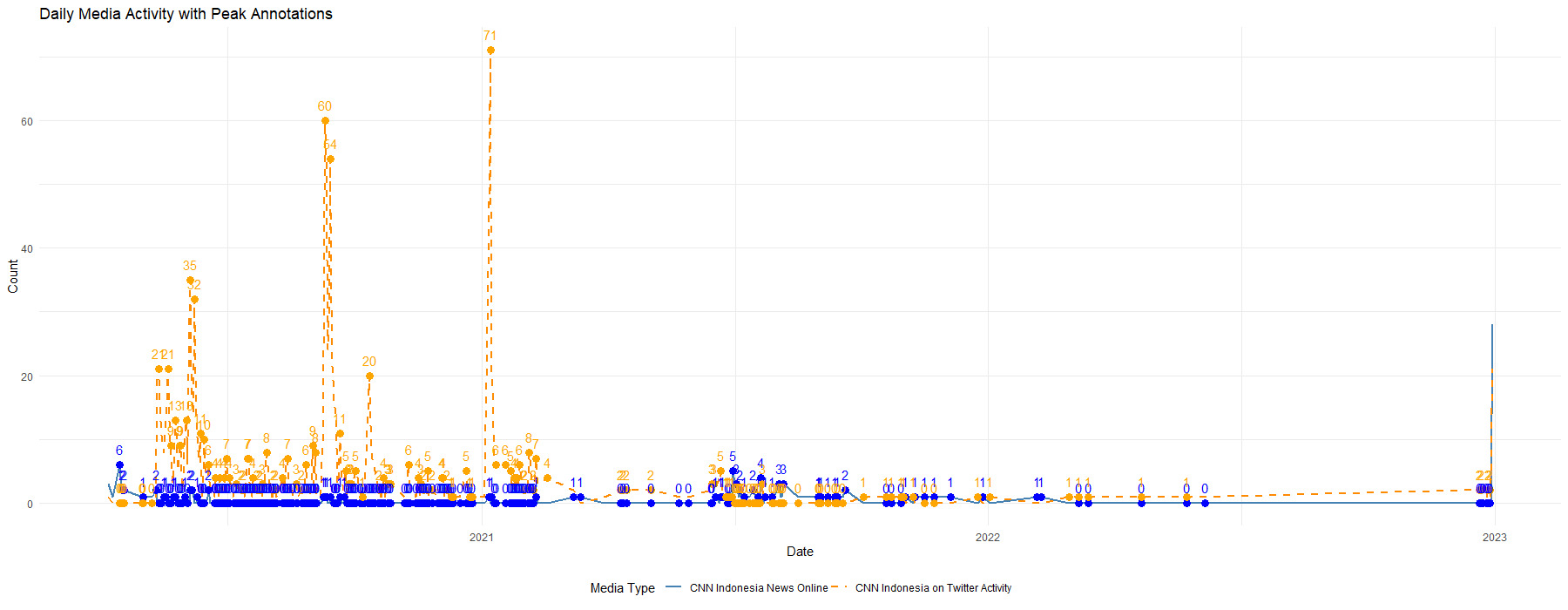
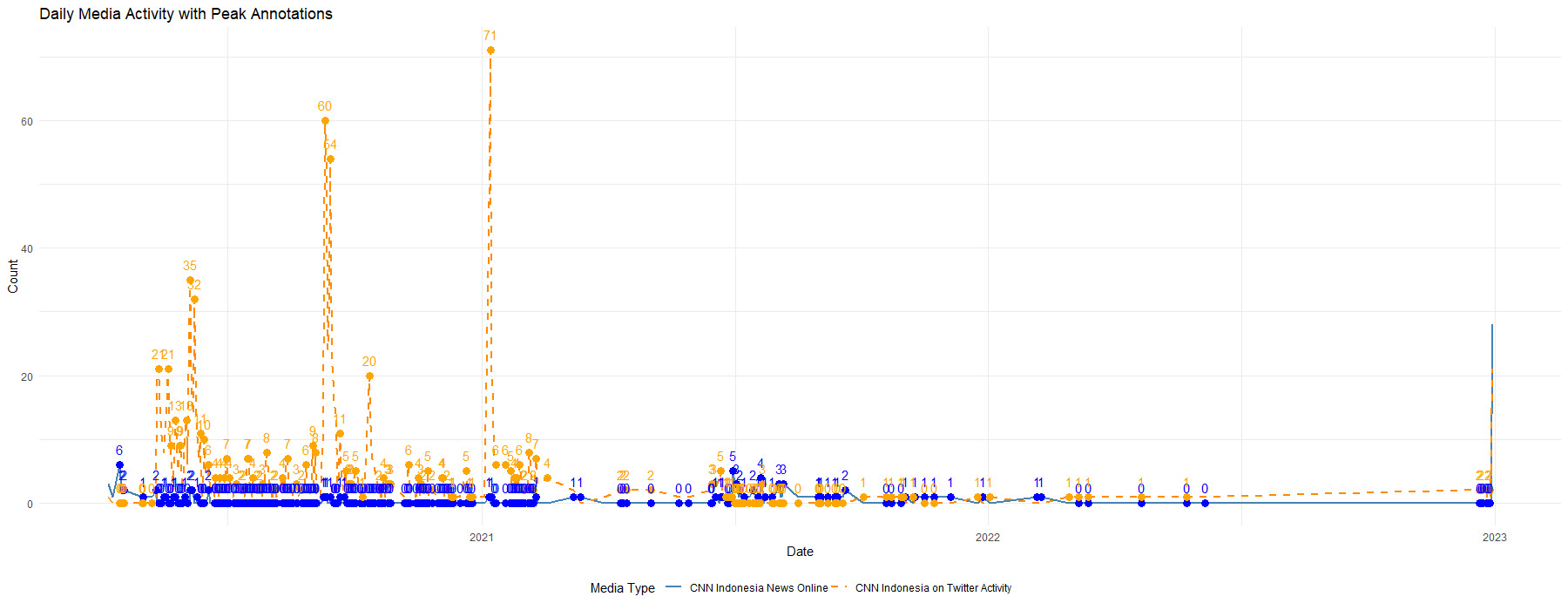
Figure 1 illustrates the distribution of CNN Indonesia’s daily activity across online news publications and Twitter posts from April 7, 2020 to December 30, 2022. The dataset captures fluctuations in media output across distinct pandemic phases, including the initial PSBB implementation, the PSBB Transition Phase, the Emergency PPKM period, and the eventual termination of restrictions. News coverage peaked sharply during moments of major policy announcements, particularly in April 2020 and July 2021, while Twitter activity exhibited more sustained engagement across multiple phases, reflecting ongoing public discussion and uncertainty.
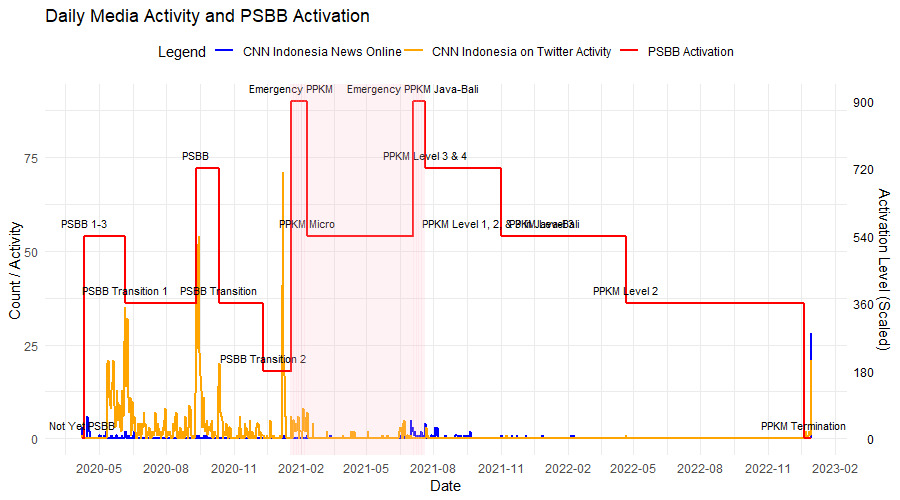
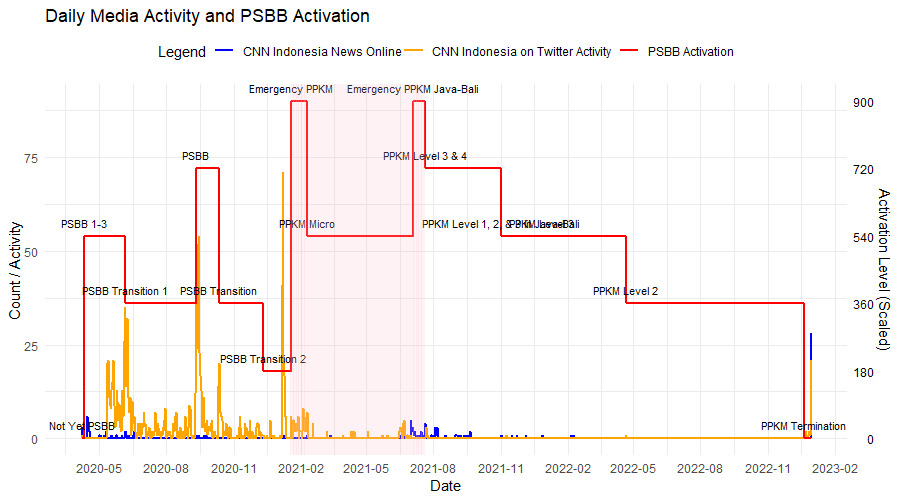
Figure 2 overlays daily media activity with PSBB activation status, enabling visual assessment of temporal alignment. Descriptive inspection reveals that increases in news and Twitter activity frequently coincided with periods when PSBB or PPKM policies were already in effect. However, no consistent pattern suggests that spikes in media activity systematically preceded policy activation. Instead, media salience appears largely reactive, intensifying during policy enforcement and transition phases rather than functioning as an anticipatory signal.
To formally assess whether media salience predicts PSBB activation, a lagged logistic regression model was estimated using one-day lagged values of CNN Indonesia news volume and Twitter activity. As shown in Table 2, the intercept term is statistically significant (β = 1.77, p = .015), indicating a baseline probability of policy activation independent of media variables. The coefficient for lagged news volume (news_lag1) is large but statistically non-significant (β = 18.16, p = .993), accompanied by a substantial standard error. This instability suggests that daily variations in news volume do not provide a reliable signal for predicting PSBB activation and may reflect sparse policy events relative to high-frequency media output. The lagged Twitter activity variable (twitter_lag1) shows a marginal association with PSBB activation (β = 0.69, p = .097). While this coefficient approaches conventional significance thresholds, the effect size remains modest, and model diagnostics indicate warnings related to fitted probabilities approaching boundary values. Consequently, this association should be interpreted with caution and does not constitute robust evidence of media-driven policy activation.
To further examine temporal precedence, Granger causality tests were conducted using a two-day lag structure. The results indicate that CNN Indonesia news volume does not Granger-cause PSBB activation (F = 0.15, p = .862). This finding suggests that past media activity does not improve prediction of policy activation beyond the policy’s own temporal structure.
The lagged cross-correlation between daily news coverage and policy activity across a ±20-day window remained low and unstructured, with no discernible peaks indicating directional influence. The correlation coefficients remain low and unstructured across all lags, with no discernible peaks indicating directional influence. Together, the Granger causality and cross-correlation analyses provide convergent evidence that media activity does not exhibit a consistent lead-lag relationship with PSBB activation decisions.
Distributed lag models were estimated to capture potential cumulative media effects over a three-day window. Consistent with the logistic regression and causality analyses, no statistically significant distributed lag effects were detected for either news or Twitter activity.
Residual diagnostics from the distributed lag models revealed substantial positive serial correlation (Durbin–Watson statistic = 0.13, p < .001), suggesting that PSBB activation decisions are influenced by unmodeled temporal structures such as institutional inertia or endogenous policy cycles. The presence of autocorrelation highlights limitations of linear lag-based models in fully capturing the dynamics of policy decision-making in decentralized systems.
Discussion
This study examined whether media salience, measured through national news coverage and social media activity, exerted short-term causal influence on the activation of Indonesia’s COVID-19 social restriction policies (PSBB). Using daily time-series data, lagged regression, Granger causality tests, and network analysis, the findings consistently indicate the absence of a direct temporal relationship between media exposure and policy activation. These results challenge deterministic interpretations of the CNN effect, which posit that heightened media attention compels immediate policy responses (Livingston, 1997; Robinson, 2005). Importantly, the analysis does not suggest that media is irrelevant to pandemic governance, but rather that its influence does not operate as a short-term trigger for policy activation within Indonesia’s decentralized system. The findings therefore necessitate a more conditional and context-sensitive understanding of media–policy dynamics.
A central empirical contribution of this study lies in the distinction between discursive prominence and temporal policy leverage. Network analysis revealed that national media outlets, particularly CNN Indonesia, occupied highly central positions in Twitter-based COVID-19 discourse, as evidenced by strong eigenvector centrality scores. This confirms CNN Indonesia’s role as a major agenda-setting actor in the digital public sphere. However, this discursive centrality did not translate into measurable predictive power over PSBB activation. Media visibility and connectivity, while essential for shaping narratives, proved insufficient to influence the timing of policy decisions. This finding refines agenda-setting theory by demonstrating that agenda dominance does not necessarily imply institutional responsiveness, especially when policy authority is fragmented across multiple governance levels.
The absence of short-term media effects is best understood in light of Indonesia’s decentralized governance structure. Under the PSBB framework, provincial and municipal governments retained substantial discretion over policy implementation, resulting in asynchronous activation across regions. This fragmentation weakens the capacity of national media narratives to exert uniform pressure on policymakers, as local authorities must balance epidemiological data, economic conditions, and political considerations unique to their jurisdictions (Haris et al., 2020; Mietzner, 2020). The strong autocorrelation detected in the distributed lag model further supports this interpretation, indicating that policy activation followed endogenous institutional cycles rather than reacting to exogenous media signals. In such contexts, media influence is filtered through bureaucratic inertia and intergovernmental coordination constraints.
These findings align with scholarship emphasizing that media effects are contingent on institutional receptivity and elite consensus (Vliegenthart et al., 2016). During the COVID-19 pandemic, Indonesian policymakers faced competing priorities and uncertainties that reduced the likelihood of rapid media-driven decision-making. Media coverage tended to respond to policy announcements rather than precede them, suggesting a reactive rather than directive role. This temporal ordering challenges the core assumption of the CNN effect as a linear mechanism and supports Livingston’s (1997) argument that media influence is conditional rather than automatic. In decentralized systems, policy responsiveness depends less on media volume and more on institutional alignment and political feasibility.
An additional factor weakening the media–policy linkage is the evolving landscape of media trust during the pandemic. Early inconsistencies in official communication and politicization of health measures eroded public confidence in mainstream media and government messaging (Lim & Prakash, 2021). This erosion reduced the capacity of media narratives to generate sustained public pressure capable of influencing policymakers. Although social media platforms, such as Twitter, facilitated widespread discourse, the analysis found no robust evidence that digital mobilization translated into policy activation. This supports prior findings that online attention, in low-trust environments, often lacks the institutional pathways necessary to effect policy change (Chadwick & Fatema, 2009).
The findings are better explained through two-step flow theory and communication ecology frameworks than through direct media-effects models. Rather than responding directly to national media coverage, policymakers and citizens alike relied on trusted intermediaries, including local leaders, health professionals, and community figures, to interpret and legitimize information (Katz et al., 2006; Sobari, 2022). Empirical studies during the pandemic demonstrated that such intermediaries played a decisive role in shaping compliance and local responses (Miftah et al., 2024). In Indonesia, where regional autonomy is strong, these local actors often outweighed national media outlets in influencing policy acceptance and implementation, thereby weakening the direct transmission mechanisms assumed by the CNN effect.
To conceptualize these dynamics, this study advances the notion of media–policy disconnection. Media–policy disconnection is defined here as an empirical condition in which media salience, despite high discursive visibility and network centrality, does not temporally precede or predict policy activation in lag-based causal tests. The evidence supporting this condition includes non-significant lagged regression coefficients, null Granger causality results, unstructured cross-correlation patterns, and strong residual autocorrelation indicative of endogenous policy timing. This concept does not imply media irrelevance but rather highlights a decoupling between media attention and short-term policy activation under decentralized governance.
Theoretically, these findings contribute to ongoing efforts to move beyond deterministic models of media power. Mediatization theory suggests that media influence operates through long-term institutional adaptation rather than immediate responsiveness (Strömbäck & Esser, 2017). The Indonesian case demonstrates that media functions as a terrain of negotiation, shaping discourse, legitimacy, and public understanding, while policy activation remains contingent on institutional structures and local agency. By integrating mediatization, two-step flow, and governance fragmentation perspectives, this study reframes the CNN effect as a context-dependent mechanism rather than a universal law.
Several limitations should be acknowledged. The first limitation concerns the measurement of policy outcomes. By focusing on PSBB activation as a binary daily indicator, the analysis captures whether and when formal restrictions were put into place, but not how stringent they were, how consistently they were enforced, or how long specific measures remained in effect. As a result, any media influence that operates through adjustments in policy intensity, duration, or implementation practices rather than through formal activation events may not be detected in our models.
The analysis focuses on national-level media indicators and a binary policy activation measure, which may obscure region-specific dynamics and longer-term policy processes. Future research should employ subnational models, alternative outcome variables such as policy stringency indices, and mixed-method approaches incorporating elite interviews. Comparative studies across decentralized democracies would further clarify the generalizability of the media–policy disconnection observed here. Nonetheless, this study offers a robust empirical and theoretical contribution by demonstrating that in decentralized crisis governance, media influence is indirect, mediated, and temporally dispersed rather than immediate and coercive.
Beyond governance structure and media trust, the empirical patterns observed in this study also point to the temporal mismatch between media rhythms and policy cycles. Media attention during the pandemic followed rapid, event-driven surges shaped by infection spikes, announcements, and symbolic moments, whereas policy activation unfolded through slower, deliberative processes involving coordination across ministries, provincial governments, and local task forces. This mismatch weakens the capacity of short-term media salience to translate into immediate policy outcomes. The strong residual autocorrelation detected in the distributed lag models suggests that PSBB activation was driven primarily by internal institutional logics and path-dependent decision-making rather than exogenous informational shocks. In this sense, media attention functioned more as a contextual backdrop than as a policy catalyst.
This temporal decoupling reinforces the argument that media influence in decentralized crisis governance operates through diffuse agenda conditioning and legitimacy-building, rather than through direct triggering mechanisms assumed by classic CNN effect formulations. In sum, the Indonesian COVID-19 response illustrates that the absence of short-term media effects is not a failure of media influence but a reflection of governance complexity. Understanding media–policy interactions in such contexts requires abandoning linear causality models and embracing relational, multi-level, and trust-sensitive frameworks.
The analysis suggests that, at the level of national PSBB activation, decisions were more closely aligned with institutional dynamics and decentralized authority structures than with immediate spikes in national media coverage. However, because the models do not explicitly compare provinces or districts, the findings should not be read as a comprehensive test of decentralization across Indonesia’s regions. Instead, decentralization is used here to explain why central authorities may struggle to convert high media visibility into rapid, coordinated restrictions in a fragmented governance environment. This reconceptualization advances both media-effects theory and crisis governance research, providing a more realistic account of how media power operates under conditions of uncertainty and institutional fragmentation.
Conclusion and Recommendations
The analysis of Indonesia’s COVID-19 response shows that intense domestic media visibility around PSBB did not translate into clear, short-term shifts in national restriction activation, challenging expectations derived from classical CNN effect accounts. By situating this null short-term association within a framework that emphasizes decentralization, mediatization, and networked public spheres, the study refines critiques of the CNN effect and proposes a more relational account of media–policy interaction in domestic crisis governance. Rather than simply confirming that media power is limited, it specifies how fragmented authority and institutional filtering shape when, how, and to what extent media visibility can matter for policy choice.
Rather than indicating the absence of media influence, the findings point to a media–policy disconnection in the short term, where media visibility and policy timing operate on different temporal and institutional logics. Media attention followed rapid, event-driven rhythms, whereas PSBB activation unfolded through slower, deliberative processes involving coordination across multiple levels of government. This temporal mismatch, reinforced by strong residual autocorrelation in the distributed lag models, suggests that policy activation was shaped more by path-dependent decision-making and bureaucratic cycles than by exogenous informational shocks. Media, therefore, functioned as a contextual force that shaped discourse, legitimacy, and public awareness, but not as an immediate policy trigger. These conclusions should be read as pertaining to short-term activation decisions rather than to the broader trajectory of restriction intensity or enforcement, which constitute additional policy dimensions not captured by our binary outcome measure.
The results support a conditional and context-sensitive understanding of media influence. National media acted as agenda-setters within the public sphere, yet their capacity to exert pressure on policymakers was filtered through institutional fragmentation, local political discretion, and trust-based mediation networks. Smaller and regionally focused media outlets, along with community intermediaries, remained central to translating national narratives into locally meaningful frames. This finding underscores the importance of moving beyond deterministic media-effects models and adopting frameworks that recognize mediated influence, institutional receptivity, and governance complexity in decentralized democracies.
From a policy perspective, these findings carry important implications for crisis communication strategies. In decentralized and pluralistic contexts such as Indonesia, effective policy communication cannot rely solely on national media amplification. Instead, governments should prioritize multi-level communication architectures that integrate trusted local intermediaries, including religious leaders, health professionals, civil society actors, and regionally embedded media. Strengthening coordination between national messaging and local communicators can enhance policy legitimacy, reduce misinformation, and improve compliance without assuming immediate responsiveness to media salience.
Future research should extend this analysis by examining subnational policy variation, incorporating longer temporal horizons, and integrating qualitative evidence from policymakers and intermediaries to further unpack the mechanisms of mediated influence. Comparative studies across decentralized democracies would also help clarify whether media–policy disconnection represents a broader structural condition rather than a context-specific anomaly. Ultimately, we argue for a shift from linear models of media-driven policy change toward relational frameworks that conceptualize media influence as indirect, conditional, and embedded within complex governance ecologies. Such a reconceptualization is essential for understanding the evolving role of media in crisis governance under conditions of uncertainty and institutional fragmentation.