
China faces one of the highest burdens of cervical cancer worldwide, accounting for 18% of global cervical cancer incidence and 17% of global deaths in 2020 (Singh et al., 2022). While these figures reflect the population size, i.e., China has roughly 18% of the world’s population, and the age standardized incidence and mortality rates in China remain lower than those in many lower-income countries, the number of cases is substantial, underscoring the need for continued prevention and vaccination efforts (Singh et al., 2022; Zhang et al., 2025). The human papillomavirus (HPV) vaccine is a critical primary preventive measure for reducing the burden of cervical cancer morbidity and mortality. China approved its first HPV vaccine in 2016, and by 2021 several regions had begun offering free HPV vaccination to adolescent girls aged 13–14, primarily through school-based programs (Wu et al., 2023). Despite these policy advances, national HPV vaccination uptake remains low. By the end of 2022, approximately 10% of China’s eligible population (females aged 9-45) had received at least one HPV vaccine dose (Hu et al., 2024). This figure, however, must be interpreted cautiously. Because China introduced the HPV vaccine only in 2016 and its free vaccination programs target adolescent girls aged 13–14, the majority of the population has never been age-eligible for publicly funded vaccination. Consequently, the low overall coverage reflects not only uptake challenges but also limited eligibility windows. University students, many of whom reach the typical age of sexual initiation, fall outside the free vaccination policy. Ensuring vaccination access for this group is particularly important for reducing cervical cancer morbidity and preventing other HPV-related conditions (H. Wang et al., 2023).
A growing number of young people now rely on social media as a primary source of health information (Lim et al., 2022). Beyond the context the content of the posts, the online comments that accompany them have become as an important source of supplementary information and a reflection of public opinion (Boot et al., 2021). These online comments increasingly shape attitudes and behavioral intentions (Schindler & Domahidi, 2021). However, existing research has mostly focused on commercial or consumer contexts, with limited attention to their influence on health behaviors. In cultures that emphasize group harmony such as China, social norms and public opinion often exert strong influences on individuals’ decision-making (H. Liu et al., 2010). As a visible form of public expression, online comments may therefore carry heightened weight in shaping perceptions.
Within these comments, valence is defined as the extent to which stances are positive or negative and has been shown to significantly impact individuals’ attitudes and decision-making (Purnawirawan et al., 2015). In HPV vaccine discussions, both supportive and opposing comments frequently coexist (Feinberg et al., 2015). Given this polarization, it is essential to examine whether the valence of the comments influences individuals’ intention to vaccinate. Drawing on the elaboration likelihood model (ELM) (Petty & Cacioppo, 1986), such valence can be understood as a peripheral cue, while argument strength reflects the quality of information processed via the central route. Prior work demonstrates that comments containing objective and credible arguments are perceived as more persuasive and popular in HPV vaccine discussions (Tuhkala, 2016), underscoring the importance of argument quality. However, while the ELM specifies how information may be processed, it does not explicate the psychological mechanisms through which message attributes shape behavioral intention. Self-efficacy is a well-established determinant of health behavior (De Vries et al., 1988; Sheeran et al., 2016) and may be one pathway through which online comments affect vaccination intention, but evidence for this mechanism remains limited.
To address these gaps, the present study employed an experiment to examine how comment valence, argument strength, and self-efficacy shape HPV vaccination intentions. In doing so, this study advances our understanding of online comments in health decision-making and offers insights for developing more effective HPV vaccination communication strategies.
Literature Review
Effects of Comment Valence on Behavioral Intention
The theory of planned behavior (TPB) posits that behavioral intention is predicted by three key components: attitude toward the behavior, subjective norms, and perceived behavioral control (Ajzen, 1991). Among these factors, attitude has consistently been confirmed as one of the strongest predictors of behavioral intention in health communication (McEachan et al., 2011). However, traditional TPB models often treat attitudes as relatively stable constructs without adequately addressing how external information sources dynamically shape these cognitive evaluations in digital environments (Conner et al., 2000). In the contemporary digital landscape, individuals are immersed in a continuous flow of user-generated content where attitudes are malleable, shaped not only by direct persuasive messages but also by indirect cues such as the tone, valence, and perceived consensus within online comments (Fan et al., 2022; Sung & Lee, 2015). This dynamic environment challenges the assumption of static attitudes in TPB, highlighting the need to examine how real-time exposure to digital discourse can recalibrate attitudinal judgments and, in turn, behavioral intentions.
Online comments, as a prevalent content of user-generated content in cyberspace, serve as an indicator of public sentiment and opinion (Friemel & Dötsch, 2015; Ziegele et al., 2017). Specifically, comment valence directly reflects the attitudinal tendency of the public toward a given issue. For example, opposing comments notably reduced smokers’ enthusiasm for trying e-cigarettes versus supportive comments (Lee et al., 2020; Shi et al., 2022). Similarly, reading pro-vaccination comments was more likely to generate positive attitudinal responses than comments expressing vaccine hesitancy or opposition (Duong & Nguyen, 2022; Weber et al., 2019). These findings underscore that supportive comments about health-promoting behaviors are effective in fostering positive attitudes toward those behaviors. Considering the power of attitude in foreseeing behavioral intentions, we propose:
H1: Individuals exposed to positive online comments will report stronger HPV vaccination intentions than those exposed to negative comments.
Argument Strength in Persuasiveness
Building on TPB’s insight into the role of attitude, comment valence functions as an attitudinal cue that influences the behavioral intentions of individuals exposed to these comments. Although valence provides a directional input to attitude, achieving a stronger and more stable intention hinges on the depth and manner of information processing. Proposed by Petty and Cacioppo (1986), ELM describes two information-processing routes; the central route, which is activated when individuals are motivated and highly involved, while the peripheral route emerges when motivation or ability is limited (Petty & Cacioppo, 1986). Within this framework, argument strength, which is defined as the logical soundness, evidentiary backing, and persuasive power of a message, play a pivotal role (Wolfgang & Bhandari, 2020). Strong arguments tend to contain stronger and more substantial and detailed evidence, which can increase the persuasiveness of the message to some extent and can generate a considerable change in behavioral intentions (Zesch & Gurevych, 2009). In contrast, weak arguments may generate only superficial acceptance, leaving individuals more vulnerable to counter persuasion.
In digital health contexts, such as online HPV vaccine discussions, argument strength is especially salient because individuals often encounter diverse, user-generated content with varying degrees of credibility and quality. When users are motivated and capable of processing information (e.g., those actively seeking health advice), they are more likely to engage the central route, making the persuasiveness of strong arguments particularly influential (Carpenter, 2015). Conversely, when motivation is lower, users may rely on peripheral cues such as comment valence, popularity, or perceived consensus (Leong et al., 2019). This dual-processing framework underscores why examining both argument strength and valence together is necessary for understanding how online comments shape vaccination intentions.
However, there is an inconsistency in some research. For example, Rains (2007) revealed that strong argument comments may not be more effective in changing behavioral intentions than low argument comments. This may be because, despite the poor quality of the message of some comments, the volume of comments affects the recipient’s perceptions and makes the argument appear better than it actually is. In addition, an individual’s cognitive style, how they process information, and how much they trust the source of the information can also influence the argument strength (Petty & Wegener, 1998). These inconsistencies suggest that the influence of argument strength may depend on specific contexts or on how it is configured with other message attributes. Accordingly, this study does not focus on a standalone main effect of strength but instead emphasizes condition-level differences. When individuals are exposed to large amounts of information, they tend to allocate more attention to extreme (vs. moderate) information (Fiske, 1980; Ludvig et al., 2018). A positive comment with strong arguments signals the strongest support, whereas a negative comment with weak arguments conveys a mild form of opposition. It is plausible that strong positive comments could be more likely to increase HPV vaccination intentions than weak negative comments. However, empirical research based on psychological resistance theory shows that when the persuasive intention of the message is significant and the argument strength is high, it will trigger the audience’s perceived threats to autonomy and resistance (Coppola & Girandola, 2017; W. Wang & Shen, 2019). Positive comments with strong arguments are more likely to be identified as having a clear persuasive intention, potentially eliciting individual psychological resistance and thus weaken their positive impact on HPV vaccination intentions. Based on the above views, the relative performance of positive comments with strong arguments versus negative comments with weak arguments in shaping vaccination intention is not straightforward, thus, we pose the following research question:
RQ1: How do the valence (positive vs. negative) and argument strength (strong vs. weak) of online comments influence young women’s intentions to receive the HPV vaccine?
The Mediating Role of Self-Efficacy
In light of TPB and ELM, the effects of online user comments on vaccination intention can be explained by individuals’ processing of two key informational attributes of the comments: comment valence and argument strength. Nevertheless, persuasive effects are not limited to direct routes and may also work indirectly by reshaping individuals’ cognitive structures. According to social cognitive theory, self-efficacy is seen as an important element to behavior change, as it represents an individual’s belief in their ability to successfully complete a task and serves as a significant predictor of behavioral intention (Bandura, 1986; Cho & Lee, 2015). Unlike attitudes or norms, which reflect evaluations or social pressures, self-efficacy directly influences whether individuals feel capable of translating intentions into action. Extant studies show that high self-efficacy is linked to greater intentions for health behaviors, such as receiving the HPV vaccine or undergoing cervical cancer screening, compared to low self-efficacy (S. Kim & Hmielowski, 2017). Moreover, self-efficacy frequently functions as a mediator, demonstrating its mediating effect on other influential factors, including knowledge, attitudes, and social influences, on behavioral intention (Choi & Noh, 2023; Khusaini & Anwar, 2023; Yang et al., 2023). This mediating role of self-efficacy may explain why some individuals with positive attitudes and knowledge still do not act, whereas others with high self-efficacy are more likely to take action.
Bandura (1977) outlined that self-efficacy can stem from several sources, among which “vicarious experience,” “verbal persuasion,” and “emotional state” are all closely tied to the valence of online comments. Specifically, online comments reflect others’ experiences, and success stories in positive comments can boost self-efficacy. In addition, positive comments often include encouraging language and uplifting emotions, which help strengthen bolster self-efficacy. In contrast, negative comments may highlight failures or convey discouraging emotions, sparking doubt and worry that weaken self-efficacy. Malloch and Feng (2022) suggested that positive comments enhanced individuals’ self-efficacy in providing support, whereas negative comments diminished it. This dynamic suggests that online comments may shape behavioral intentions not only by influencing attitudes (as TPB emphasizes) or through information processing routes (as ELM explains), but also by altering individuals’ confidence in their ability to act. In this sense, self-efficacy provides a crucial psychological mechanism that links message features, such as comment valence and argument strength, to HPV vaccination intentions. Based on this understanding, the subsequent hypothesis is introduced:
H2: Self-efficacy mediates the relationship between the valence of online comments and HPV vaccination intentions.
Some studies have demonstrated that argument quality positively influenced individuals’ self-efficacy in a special context, such as professional service, such as consulting or other knowledge-intensive services (Cassia & Magno, 2021). Many existing studies have found that strong arguments can significantly increase the level of trust in comments (Tran & Can, 2020) and enhance their perceived usefulness (Meek et al., 2021). This credible and useful information tends to be more socially persuasive, thus having a potential role in improving self-efficacy (Hendricks, 2016). Together, these findings suggest that argument strength can operate not only as a persuasive factor but also as a psychological resource that shapes individuals’ confidence in their ability to act.
However, most studies have been conducted in neutral or single-stance information environments, overlooking valence differences. In practice, however, valence is unavoidable because comments almost always contain evaluative orientations that influence how arguments are interpreted. Comment valence, inherently carrying attitudinal orientations, can trigger stronger evaluative reactions among audiences (Ajzen, 2001). According to cognitive dissonance theory, individuals experience psychological discomfort when encountering information inconsistent with their existing attitudes or beliefs, prompting attitude adjustment, information avoidance, or reinterpretation to reduce dissonance (Festinger, 1962). This discomfort is not trivial; it can undermine individuals’ sense of capability. This dissonance may intensify when facing high-quality and difficult-to-refute inconsistent information. Research indicates that strong belief-inconsistent information reduces self-efficacy, leading to avoidance strategies (Goldberg et al., 2020). Therefore, in contexts with varying comment valence, the direction and strength of argument strength on self-efficacy may change. This possibility raises the need to investigate how argument strength interacts with valence in shaping self-efficacy, which in turn influences behavioral intentions. Based on this, the present study proposes the following research question:
RQ2: How does self-efficacy function as a mediator between the argument strength of online comments and individuals’ HPV vaccination intentions?
Method
Respondents
The study included 200 participants, and all data were collected through the online platform Wenjuanxing, one of the largest survey platforms in China. Respondents were recruited from Wenjuanxing’s internal participant pool, which consists of registered users who voluntarily take part in surveys, using a convenience sampling approach. The participants were adult female college students from China aged 18 and above. The inclusion criteria were that they had not received the HPV vaccination, were not majoring in a medical field, and were familiar with the use of social media. All participants received information regarding the research aims before completing the questionnaire and were assured of anonymous processing to ensure data privacy and voluntary participation.
Study Design and Procedures
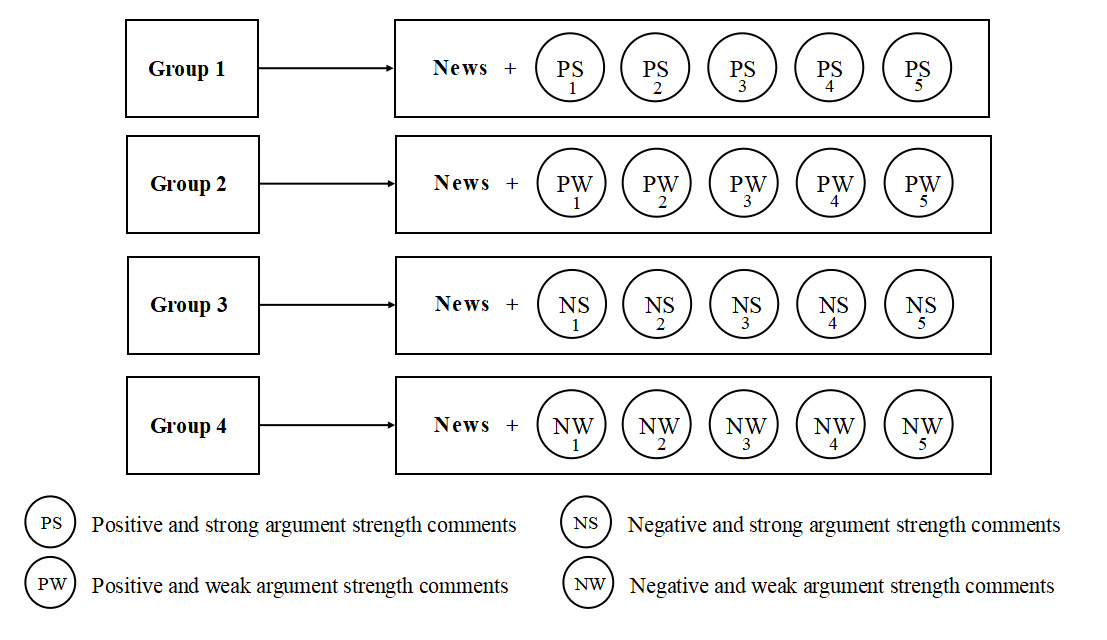
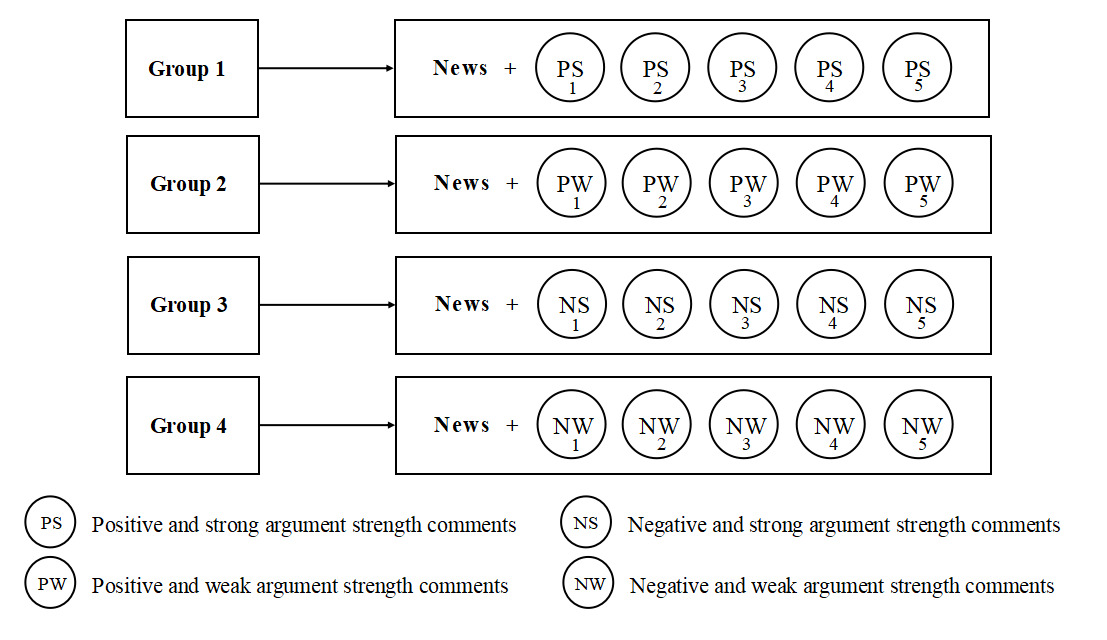
The research adopted a 2-valence (positive vs. negative) × 2 argument strength (strong vs. weak) between-subject experimental design. Based on the design, one of the four different conditions (X1, X2, X3, and X4) was randomly assigned to participants. X1 refers to the condition of positive and strong argument strength comments; X2 refers to the condition of positive and weak argument strength comments; X3 refers to the condition of negative and strong argument strength comments; and X4 refers to the condition of negative and weak argument strength comments. Each subject was randomly allocated to one of the four experimental conditions. Following the treatment’s implementation, participants were instructed to complete the questionnaire to assess their perceived valence, perceived argument strength, self-argument strength, and HPV vaccination intentions. Figure 1 shows the experimental conditions and composition for each condition.
Stimuli
Four different versions of Weibo posts were created. Each post includes the same article addressing cervical cancer risk and HPV vaccine benefits, followed by five different comments. To maintain external validity, the news and comment scenarios were extracted from an actual news article on Sina Weibo, with small changes to ensure suitability for the research. The message addresses cervical cancer risk and HPV vaccine benefits based on the standard format of a fear appeal (Lu & Sun, 2022; Rogers, 1983). All posts were in the message comprises a threat-to-health component and a recommendation component. The threat-to-health component mentions the severity and vulnerability of a disease or virus posed to people. For instance, “80% of women will be infected with HPV at least once in their lifetime, and persistent infection with high-risk HPV over a period of up to 10 years can greatly increase the likelihood of developing cervical cancer.” The recommendation components point out the effectiveness of protective action; for example, “The HPV vaccine works extremely well to prevent high-risk HPV and the disease it can cause.” The length of the news article is around 200 words.
Comments are defined as positive if they (a) directly support HPV vaccination or (b) express a positive evaluation of the HPV vaccine. Comments are defined as negative if they (a) directly oppose HPV vaccination or (b) express a negative evaluation of the HPV vaccine. Comments are categorized as strong arguments if they (a) provide significant and logical points for supporting/opposing HPV vaccination or (b) provide persuasive evidence (statistics, data, link, authority, etc.) in support of their thoughts. Comments are categorized as weak arguments if they (a) provide insignificant and illogical points for supporting/opposing HPV vaccination or (b) just express an opinion without any supportive evidence or rely more on quotations and personal opinions and examples to support their position. Table 1 presents examples of online comments.
Measures
Perceived valence was assessed using a single-item scale following Liu and Shi (2019). Participants were asked to rate the emotional tone of each user comment on an 11-point semantic differential scale, ranging from 1 (very negative) to 11 (very positive).
Perceived argument strength was evaluated using a five-item scale adapted from Zhao et al. (2011). Participants were asked to rate the following statements about each user comment on a 5-point scale (e.g., “The comment gives a convincing reason for getting the HPV vaccine.”). Responses were measured on a 5-point Likert scale ranging from 1 (strongly disagree) to 5 (strongly agree). The score for perceived argument strength was calculated by averaging the responses to the five items (Cronbach’s α = 0.84).
Self-efficacy was assessed using a 4-item scale adapted from Arkorful et al. (2023), with minor revisions. Participants were asked to assess their confidence in their ability to receive the HPV vaccine. Items include “I am able to get the HPV vaccine,” “It is easy to get the HPV vaccine,” “I can get the HPV vaccine without much difficulty,” and “It’s easy for me to decide to get the HPV vaccine.” The items were rated on a 5-point Likert scale ranging from 1 (strongly disagree) to 5 (strongly agree). The self-efficacy score was the average of these four items (Cronbach’s α = 0.90).
The HPV vaccination intention variable was measured through a four-item scale modified from Gainforth et al. (2012). Participants responded to statements like “I am ever ready to avail myself for HPV vaccination in future” on a 5-point Likert scale (1 = strongly disagree, 5 = strongly agree). The intention score was determined by averaging the responses to the four items (Cronbach’s α = 0.87).
Data Analysis
Data were analyzed using SPSS 26.0 to test the proposed hypotheses. The independent samples t-test and PROCESS macro for SPSS (Model 4) were used to test the manipulation and hypothesis, respectively. For all analyses, p-values less than .05 were considered statistically significant.
Results
Manipulation Check
The manipulation of the comment’s valence and argument strength was successful. Participants under the positive condition considered the comments to be far more positive (M = 8.9, SD = 1.7) than those under the negative condition (M = 3.6, SD = 2.1, t (961) = 43.06, p .001). In addition, participants under the strong argument strength perceived more argument strength (M = 3.7, SD = 0.6) than those under the weak argument strength (M = 3.6, SD = 0.85, t (920) = 2.46, p = .014).
Hypothesis Testing
To evaluate H1, an independent samples t-test was performed to determine whether the valence of online comments (positive vs. negative) had a significant effect on participants’ intentions to receive the HPV vaccine. In support of H1, the analysis revealed that participants who viewed positive comments (M = 4.0, SD = 0.7) had significantly higher vaccination intentions compared to those who viewed negative comments (M = 2.4, SD = 0.7, t (198) = -15.50, p < .001).
To explore RQ1, an independent samples t-test was conducted to compare HPV vaccination intentions between participants who were exposed to positive, strong arguments and those who were exposed to negative, weak arguments. Results showed that participants in the positive, strong-argument group (M = 4.0, SD = 0.7) reported significantly higher intentions to receive the HPV vaccine compared to those in the negative, weak argument strength group (M = 2.6, SD = 0.8, t (98) = 9.80, p < .001).
To test H2 and explore RQ 2, mediation analysis was conducted using the PROCESS macro (Model 4) in SPSS. Self-efficacy was examined as a potential mediator between both comment valence and argument strength on HPV vaccination intentions.
As shown in Table 2, the total indirect effect of comment valence on vaccination intentions was significant, as indicated by the bootstrapped confidence interval not containing zero (95% CI [0.004, 0.649]), confirming that self-efficacy mediates the relationship between comment valence and vaccination intentions. Specifically, positive comment valence increased self-efficacy (b = 1.71, SE = 0.08, p < .001), which in turn significantly predicted higher vaccination intentions (b = 0.19, SE = 0.08, p = .020). H2 was supported.
However, the mediation analysis did not support the proposed indirect effect of argument strength through self-efficacy on vaccination intentions (b = 0.03, 95% CI [−0.16, 0.23]). Additionally, the direct effect of argument strength on HPV vaccination intention remained non-significant (b = -0.12, p = 0.260). In response to RQ2, self-efficacy does not mediate the relationship between the argument strength of online comments and individuals’ HPV vaccination intentions.
Discussion
This study examined the influence of online comments on HPV vaccination intentions among female college students, focusing on the role of comment valence (positive or negative), argument strength, and self-efficacy. The findings provide valuable insights into how online public comments influence young women’s health decisions.
The findings indicate that positive comments were associated with higher vaccination intentions compared to negative comments. This finding aligns with social influence theory, positing that positive social cues can enhance one’s incentive to be involved in health activities (Cialdini & Goldstein, 2004). A large number of comments can create a climate of “public opinion” where individuals feel that the majority of people are either for or against the behavior (e.g., vaccination). Due to people’s natural tendency to follow the crowd, they tend to conform to the prevailing view or conduct to reduce the potential risk of social exclusion (Bindra et al., 2022). These mechanisms suggest that online comments can serve as powerful normative signals. While not directly measured in this study, collectivist cultural tendencies may explain the heightened sensitivity to social cues. In such cultures, individuals tend to emphasize social harmony and conform to group norms when making decisions (Triandis, 1995). Therefore, individuals, especially in collectivistic or interdependent cultures, tend to rely more on social cues to navigate uncertainty and validate their decisions, making online comments particularly influential as indicators of perceived collective opinion. In contrast, individualistic culture prioritizes self-reliance and independent judgment, reducing individuals’ tendency to be influenced by external comments. This cultural distinction provides a possible explanation for cross-cultural differences in prior findings. It could help explain why the present study found a direct link between comment valence and vaccination intentions, whereas research in more individualistic contexts has reported no substantial direct effect (Weber et al., 2019). Future studies can further explore the differential effects of comments in different cultural contexts, which will have important practical implications for designing more culturally sensitive public health communication strategies.
It is difficult to capture how comments have an effect by examining a single attribute. Therefore, many studies have explored the interactions between comment valence and multidimensional attributes such as comment tone, approval ratings, and vertical order in order to better understand the comment’s overall impact (Duong et al., 2019; H. Kim et al., 2020; Lu & Sun, 2022). However, the role of argument strength has been underestimated in studies of user comments. Argument strength is often widely discussed in the field of information design, especially in media or organizational communication strategies (Djupegot, 2019; Lien & Chen, 2011). This is mainly because information released by organizations or the media is carefully crafted, where argument strength can play a significant role. In contrast, the overall argument strength of user comments tends to be weak, often dominated by personal experiences, feelings, or subjective perceptions rather than using a strict argumentation structure (Naab & Sehl, 2017). Nevertheless, even in informal environments such as comment sections, relative differences in argument strength still matter. This study reveals that strong and positive arguments were more effective in reinforcing HPV vaccination intentions than weak and negative comments. This sheds light on the fact that even in environments where information is typically informal, the presence of well-constructed framed arguments can meaningfully increase the persuasive impact. However, argument strength alone did not exhibit a significant direct effect on vaccination intention, suggesting that the relationship between argument strength and behavioral intentions is more complex than a simple linear path.
To further explore the mechanisms by which user comments influence individuals’ behavioral intentions, we examined the mediating role of self-efficacy. Results confirmed that positive comments enhance individuals’ self-efficacy, which in turn increases their vaccination intentions. This finding aligns with social cognitive theory, which emphasizes the central role of self-efficacy in behavior adoption. It also extends the factors that influence self-efficacy. Previous research on self-efficacy in health contexts has predominantly focused on individual-level determinants and social support (Ashford et al., 2010; Peechapol et al., 2018). Our findings suggest that social information cues, specifically comment valence, can significantly influence self-efficacy formation. This may be because positive comments tend to carry emotional elements such as encouragement and support, and these emotional cues can enhance individuals’ confidence and self-efficacy (Malloch & Feng, 2022). Negative comments, on the other hand, may undermine self-efficacy by highlighting difficulties, risks, or social disapproval. Thus, comment valence appears to operate not only as a social influence cue but also as a psychological resource that shapes confidence in health behavior adoption.
In contrast, no mediating effect of self-efficacy was found for the argument strength-intention relationship. This is likely because argument strength, as a logical and evidential attribute of information, may exert its influence through other mechanisms such as enhancing persuasiveness or facilitating attitude change, rather than directly improving self-efficacy (Som, 2016). Comment valence provides social-emotional cues that directly relate to behavioral confidence, whereas argument strength offers cognitive-rational information in a comment and usually works through complex cognitive processes (Occa & Morgan, 2021). This means that strong arguments may enhance an individual’s rational endorsement of vaccination but may not directly increase their confidence or perceived ability to successfully vaccinate themselves. The cultural context in China may also play a role. In an environment that emphasizes social harmony and group conformity, audiences tend to be more sensitive to informational cues about public opinion embedded in comments, whereas the influence of logical rigor is relatively less pronounced.
Implications and Limitations
This study highlights how comment valence can directly influence vaccination intentions, revealing the substantial influence of user-generated comments on health-related behaviors. We also explored the role of argument strength, deepening the understanding of how the informational quality of comments shapes health communication. This study extends ELM by incorporating self-efficacy as a mediating factor, demonstrating that the traditional dual-route framework can be enriched by psychological constructs when explaining behavioral intentions in health contexts. It also contributes empirical evidence on user-generated comments to the health domain, expanding the scope of comment research beyond commercial and political contexts. From a practical perspective, the findings underscore the importance of optimizing online platforms to foster positive, high-quality comments that can promote healthier decision-making. Public health agencies and health communicators can promote public health behaviors such as vaccination by optimizing the user comment system to encourage high-quality positive comments and strong-argument health information sharing.
There are some limitations in the study. First, neutral comments and broader demographic groups were excluded, which may limit the generalizability of the findings. Future research could incorporate neutral comments to improve the ecological validity of experimental stimuli. In addition, including more diverse populations would provide a more comprehensive understanding. Second, this study focused on a single mediator of self-efficacy. While self-efficacy is a powerful construct that explains various behavioral outcomes, it may not fully capture the complex mechanisms relevant to health-related behaviors. Future studies could benefit from integrating health-related theoretical frameworks to examine the cognitive processes underlying the relationship between online comments and health behavioral outcomes. Third, this study did not include control variables that may influence vaccination intention, such as prior vaccine attitudes, platform usage time, and existing HPV vaccination knowledge. Future research could examine whether these individual factors moderate comment effects to identify vulnerable populations and refine theoretical boundaries.