
College students’ intention to visit various cities in Asia are driven by various factors, as highlighted in the literature. An assessment study by Seow and Hussain (2024) revealed that the reputation of a destination’s government and organizations, along with economic advancement, are key factors that attract students to visit and stay for their studies. The status of a city’s economy has also been identified as a factor for why foreign visitors to China prefer to visit certain cities in the country (Su et al., 2016). Su et al. (2016) also noted that heritage sites are preferred tourist spots, as indicated by the location-tagged photos shared on social media.
This is similar to the findings of Mohsin et al. (2017) who found that students from Thailand are motivated to visit cities where they can have cultural experiences. However, they also emphasized engaging in outdoor activities and enjoying scenic views. Cultural experiences are preferred by most Chinese college students when visiting cities; however, outdoor activities are preferred by most British college students (Xu et al., 2009). Taken together, these studies show that motivations for city choice emerge not only from attractions and cultural experiences but also from how young people encounter and interpret these destinations through various media channels. This connection is important because media exposure, familiarity, and perceptions formed from these sources eventually shape travel intentions.
Concerning logistical expectations, college students value convenience and accessibility in their destination when choosing travel destinations. For instance, Zhou et al. (2024) stated that college students consider the duration spent and seat choice during transit. However, in the study by Harz and Sommer (2022), the duration spent during transit is less of a consideration among city tourists. Travel time among students has been identified as a critical factor in visiting cities, so most of them prefer taking trains and other modes of public transportation (Shi et al., 2020). The duration of travel time is one of the indicators in the study of Al-Lami and Torok (2023) in achieving sustainable economic growth. These logistical considerations further illustrate how familiarity with a destination’s environment and transportation systems contribute to the formation of travel intention, especially when students associate efficient transport and accessibility with sustainable and well-managed cities.
On the other hand, Dagiliūtė et al. (2018) suggested that it is vital for universities to shape their students’ perceptions of the concept of sustainability. Their study added that the sustainability practices being implemented and the information being provided by the universities influence how the students exercise sustainable practices. However, Aleixo et al. (2021) argued that the efforts in implementing sustainable practices may still be strengthened from the perspective of students. Therefore, their study also suggested an increased integration of sustainability practices, especially at the secondary level, where students are seen to be more eager to learn about sustainable development. For instance, universities that implemented increased environmental initiatives enhanced students’ engagement in sustainable practices (Ribeiro et al., 2021). These findings are similar to the claim of Wang et al. (2020) that universities implementing sustainability-related campus activities influence how students commit to engaging in sustainable practices, while Boca and Saraçlı (2019) showed that college students taking courses about environmental protection had a significant influence on their attitude toward practicing sustainability. These patterns show that students form their ideas of sustainability from multiple sources, which later shape how they judge the sustainable practices of cities they consider visiting.
In Thailand it was found that students are already aware of the concepts of sustainability, specifically of infrastructure and citizens’ well-being; however, it was also noted that students find envisioning sustainable cities challenging, given these concepts and the existing living environment (Likitswat, 2019). To address urbanization, through a study conducted among post-graduate students in selected top global universities, it was found that sustainable cities and infrastructure programs, utilizing an integrated approach, provide ethical and cultural sensitivity in urban development (N. Li et al., 2018).
D’Autria’s (2018) defined sustainable cities as a form of development that addresses not only environmental problems but also deals with inequality and poverty. However, some perception studies reveal that sustainable cities only refer to the quality of the environment and public services (Macke et al., 2019). This highlights a significant gap, emphasizing the need for a broader view of sustainability that encompasses both economic and social dimensions. These studies show that students’ early exposure to sustainability, usually through their schools and immediate environment, shapes how they interpret the sustainable practices of cities beyond their own context.
Integrating the concept of sustainability with travel intention, it was revealed that the sustainability approaches of a city are vital for tourists, and they consider these as points for revisiting for tourism (Conti et al., 2023). These approaches must be integrated into the promotional strategies of cities’ tourism to attract more tourists, particularly those who are eco-friendly (Kálmán et al., 2024). They added that governments must integrate sustainability indicators in developing tourism strategies. The study was conducted in India and Hungary. In turn, sustainability information becomes part of how tourists evaluate destination appeal, which links directly to how young travelers form their early impressions of foreign cities.
However, contrasting findings from China and Italy suggest that youth in these countries are less inclined towards sustainable travel experiences, which is likely due to different motivations (Cavagnaro et al., 2021). Values and travel experiences shape the intention to travel to sustainable cities (Xiahong et al., 2023). Such differences highlight that students may weigh sustainability cues differently based on their prior exposure, which is important in understanding how Filipino college students assess the sustainable practices of the cities included in this study.
The sustainability information published by tourist destinations is vital, according to Gomes and Lopes (2023), as it influences tourists to practice sustainability and choose destinations that integrate this practice. These publications are also seen in the study of Bosone and Nocca (2022), which found that tourists become more informed, especially on sustainability concerns. However, their study also suggested increasing information dissemination from governments to tourists in addressing more complex issues. Furthermore, these sustainable preferences were also observed among frequent travelers; hence, they could influence other tourists in understanding the sustainable practices in tourism (Seeler et al., 2021). There is an indication that sustainability information becomes part of how travelers build their expectations about a place, which connects to how students form their early judgments about the sustainable practices of cities they have not yet visited.
Digital tools were also identified as promoting sustainability among tourists. This is done through the provision of various options throughout their travel to a particular destination; therefore, they could influence their tourist practices (Fragidis et al., 2022). Aside from promoting sustainability, these digital tools were also seen as factors that affect the travel intention of individuals. For instance, in the study of Raafat et al. (2023), millennials preferred influencers who have the expertise to deliver travel-related content. The content published on social media must be of high quality and high engagement, as perceived by the viewers, to influence their travel intentions (L. Li et al., 2024). Additionally, the familiarity of travel destinations influences the intention of traveling among tourists, particularly among Thais (Homsud, 2024). Media exposure functions as an early source of familiarity, which then shapes how young people imagine and evaluate cities before making travel decisions.
Aside from digital channels, traditional media, based on recent literature, may still influence travel intention. Yoon et al. (2024) found that news about destinations, whether positive or negative, affects the travel intention of tourists. Similarly, increased travel intention has also been influenced by documentaries seen on television, especially when these documentaries were able to stimulate emotional connection and a sense of well-being among their viewers (Bi et al., 2021). In addition, reality shows that feature tourist destinations also increase the travel intention of viewers. This activity prompts viewers to search more about the destination (Mege, 2021). A pattern emerges, suggesting that both media and sustainability signals contribute to how individuals construct a sense of what a city is like, which is relevant to how Filipino college students evaluate the destinations included in this study.
Some films that show celebrities and shoot locations also increase the travel intention of viewers (Luong, 2023); however, films that also show unfavorable scenes, including, for example, crime, may lessen viewers’ intention to visit. Darson et al. (2024) specified that films that affect viewers’ values and cultural interests may also motivate their intention to visit these tourist destinations. Generally, exposure to either online or traditional media, or both, may influence people’s travel intentions, provided it presents a positive image and they have experienced such destinations (Homsud, 2024).
Aside from the literature mentioned above, we recognize the importance of media in promoting not only tourist destinations, but also the sustainable practices therein. Additionally, there are limited studies on how college students, particularly Generation Z, view cities with sustainability as a consideration. Sustainable practices should be evaluated according to the United Nations Sustainable Development Goals (SDGs) (Tsalis et al., 2020). These SDGs, through case studies among cities, were used as basis for further developing cities, particularly in making them equitable and sustainable (Krellenberg et al., 2019). This study highlights the need to understand how sustainability information and media exposure work together in shaping how Filipino college students view the cities included in this study.
This study may contribute to shaping the perception of students, particularly Filipino college students in the Philippines, on sustainability, which they may also consider as a factor when choosing a travel destination in the future. Therefore, we also acknowledge that college students may not yet have the financial capacity to travel; this is why our study only focused on travel intention. This will also help governments work on sustainability as a way of not just improving their city but also enhancing its tourism appeal.
Public opinion includes listening to a specific audience’s opinion and may benefit tourism and cities in enhancing strategies to increase intentions to visit. Understanding these perceptions provides a clearer view of how young people connect sustainability cues and media exposure with their imagined experience of different cities. This study may also help educators in teaching communication and sustainability practices. Based on these arguments, this study aims to answer:
RQ1: How do Filipino college students form their travel intentions based on their exposure to media sources, familiarity of travel destinations, and their perception of cities’ sustainable practices?
Specifically, this study aimed to address the following objectives:
-
To identify the media sources influencing Filipino students’ perceptions and familiarity of selected cities in Asia
-
To assess Filipino college students’ perceptions of the sustainable practices implemented in these cities
-
To examine the travel intention of Filipino college students to these cities
Applying the destination image theory, which explores how tourists perceive a destination (Agapito et al., 2013), we examined the relationship between Filipino college students’ media sources and their travel intention, specifically through their familiarity of travel destinations and perception of sustainable practices. We also explored whether this mediated relationship differs between genders. Therefore, this study tested the following hypotheses:
H1: Exposure to a city via media sources positively influences Filipino college students’ travel intention.
H2: Exposure to a city via media sources influences Filipino college students’ travel intention by way of familiarity of travel destinations.
H3: Exposure to a city via media sources influences Filipino college students’ travel intention by way of perception of sustainable practices.
Methodology
This research study utilized a quantitative research design, specifically through a survey, to address the objectives. An online survey instrument was developed through the cross-country survey on the mere exposure effect of travel intention among students in Asia (Luo et al., 2024) and administered through the platform of the Asian Network for Public Opinion Research. The said instrument included sections on demographics, media sources, familiarity with travel destinations, perception of sustainable practices (retrieved from the qualities of the city section), and travel intention. College students were selected as the population for this study because the studies of Czepkiewicz et al. (2020) and Zhao & Yuan (2023), as cited in Luo et al. (2024) mentioned that they will have greater intention and capability for personal and business travel.
The respondents were selected through purposive sampling considering that we used our networks in Metro Manila and selected 31 universities. A total of 1,103 Filipino respondents were surveyed, which were pre-determined (students) and selected based on accessibility. The data were collected among students onsite and online, but the survey questionnaire was completed online.
Frequencies and percentages were calculated to identify media sources that influenced Filipino students’ travel intention. Travel intention and familiarity of travel destinations to selected Asian cities were measured using a six-point Likert scale. For travel intention, participants rated the cities from 1 (definitely not) to 6 (definitely), while familiarity of cities was rated from 1 (never heard of) to 6 (know it very well). We calculated based on six ranges: 1.0-1.4 = definitely not, 1.5-2.4 = probably not, 2.5-3.4 = possibly, 3.5-4.4 = probably, 4.5-5.4 = almost definitely, and 5.5-6.0 = definitely. We tallied the scores from eight city attributes for perceptions of the cities’ sustainable practices. These attributes include: cleanliness, has cultural attractions, easy to travel within the city, has a beautiful natural environment, relaxing, safe, economic center, and technological center. We included economic center as the study of Al-lami and Torok (2023) claimed that the economy is one of the four indicators sustainability, contextualizing it in public transportation, while technological center is included because it has been claimed in the study of Wang and Zhou (2022) that technological efforts, through systems and governance, support sustainable development in cities.
The data were analyzed in SPSS version 24 using Hayes’ PROCESS macro 4.2 (Hayes, 2022). All continuous variables were mean-centered prior to analysis to mitigate potential multicollinearity. Descriptive statistics and study variable intercorrelations were generated. We used PROCESS Model 4 to assess the mediating role of familiarity of travel destinations and perception of sustainable practices on the relationship between exposure to media sources and travel intention. This model was selected because it aligns with the study’s aim to understand how indirect paths contribute to the formation of travel intention among students.
Results
Table 1 presents the percent of respondents who had seen each city depicted in four different kinds of media. These results show that among these media sources, respondents were most likely to have encountered Seoul, South Korea (14.9%); Manila, Philippines (14.3%); and Cebu, Philippines (12.0%) on TV or movies. However, most cities had a very low percentage of students who had encountered them in any given type of media or social media..
Probably due to the global spread of the Hallyu wave through K-pop, music emerged as the strongest influence on perceptions of Seoul, South Korea (31.2%). Similarly, social media influenced the views of Phuket (6.9%) and Pattaya (6.7%) in Thailand. Like in South Korea, music was the dominant factor shaping perceptions of Manila, Philippines (33.3%).
Table 2 shows the familiarity of Filipino college students with the selected cities. Results revealed that outside the Philippines, students were most familiar with Seoul, South Korea, which obtained the highest mean of 4.8. On the other hand, the respondents had just heard of Penang, Malaysia, which had the lowest mean of 1.6, along with Chennai, India; Labuan Bajo, Indonesia; and Pattaya, Thailand. Overall, the students indicated that they know only a little about the selected cities, with a grand mean of 3.2. The results indicate that students rely on observable or widely shared attributes when forming perceptions of sustainability, which aligns with the study’s framework that links sustainability cues with travel intention.
Table 3 shows Filipino college students’ perceptions of the sustainable practices implemented in these cities. Results showed that respondents were somewhat likely to perceive Seoul, South Korea and Cebu, Philippines as promoting sustainability practices. However, it can also be observed that no attribute was connected to any city by a majority of respondents.
Table 4 analyzes the travel intention of Filipino college students to visit the selected Asian cities for tourism. Results revealed that the respondents were most likely to want to visit Seoul, South Korea, for vacation, which obtained the highest mean of 5.2, while they gave the lowest mean score to Chennai, India, as their least preferred city to visit, with a mean score of 3.0. Overall, the respondents reported that they will possibly visit the selected Asian cities for tourism, with a grand mean of 3.9. This indicates that leisure-related travel intention is generally positive, suggesting that Filipino college students are inclined to travel to these selected Asian destinations.
The table shows the travel intention of Filipino college students to visit the selected Asian cities for business. Results showed that the respondents mostly agreed that it is very probable to do business in Manila, which obtained the highest mean of 4.5. Meanwhile, the respondents chose Chennai, India as their least preferred place to do business, with the lowest mean score of 2.6. Overall, the respondents agreed that they will probably visit the selected Asian cities for business purposes, with a grand mean of 3.2. Compared to tourism, business travel intention appears more conservative, suggesting that students differentiate between leisure familiarity and perceived economic opportunities.
Table 6 displays the means, standard deviations, and Pearson correlation coefficients for the relevant variables. The results show that exposure to media sources was positively correlated with all three relevant variables: travel intention, r = 0.13, p < .001, perception of sustainable practices, r = 0.29, p < .001, and familiarity of travel destinations, r = 0.36, p < .001. All the study variable intercorrelations were statistically significant. These correlations support the proposed mediation pathways by showing that media exposure, familiarity, sustainability perception, and travel intention are meaningfully related.
Hypothesized Parallel Mediation Model
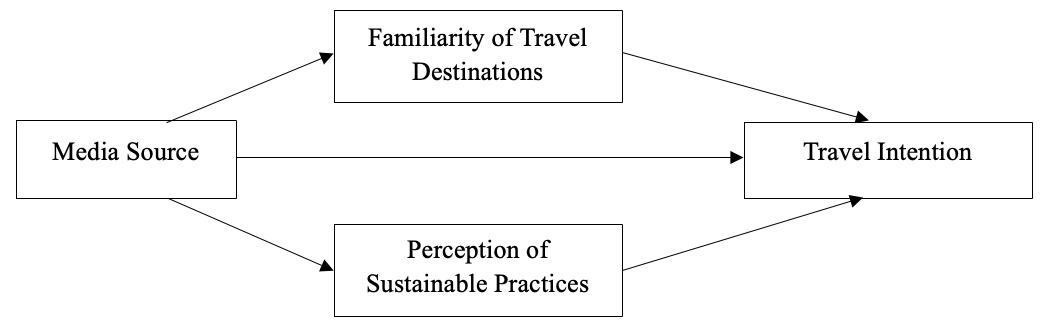
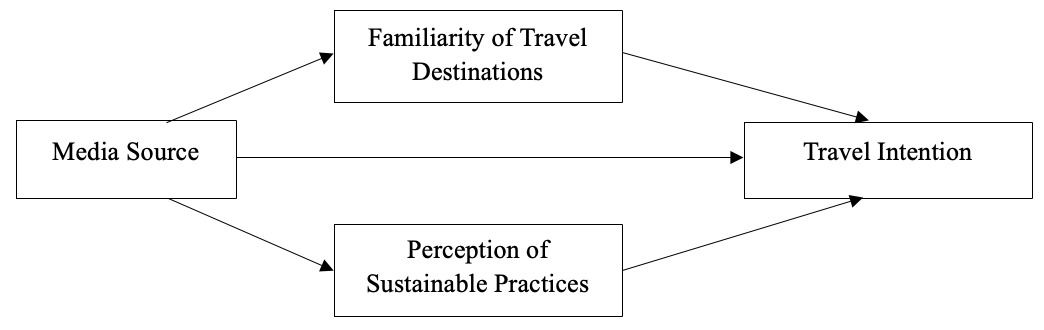
Based on the review of literature, we hypothesized a parallel mediation model that involves one independent variable (i.e., media source), two mediators (i.e., familiarity of travel destinations and perception of sustainable practices), and one dependent variable (i.e., travel intention). In this model, we hypothesized that the media source influences the respondents’ travel intention through their familiarity of travel destinations and their perception of the cities’ sustainable practices. We tested this parallel mediation using Model 4 of Hayes’ PROCESS macro in SPSS. This model is appropriate because it allows the study to examine how familiarity and sustainability perception operate as indirect pathways in understanding travel intention. The following section presents the results of the mediation analysis.
Tests for Mediation Effects
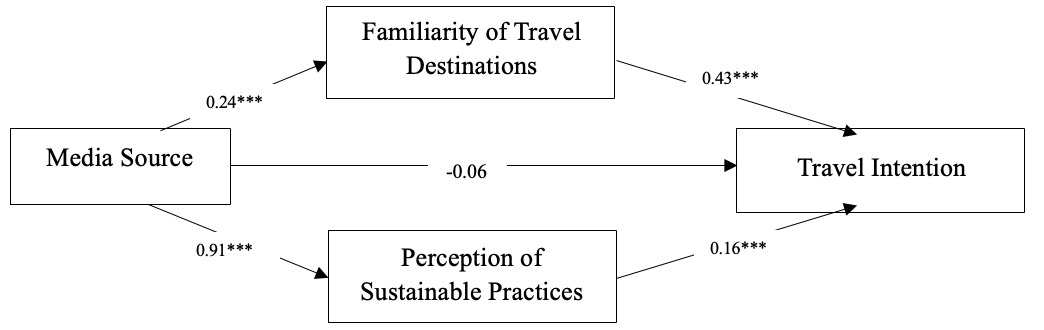
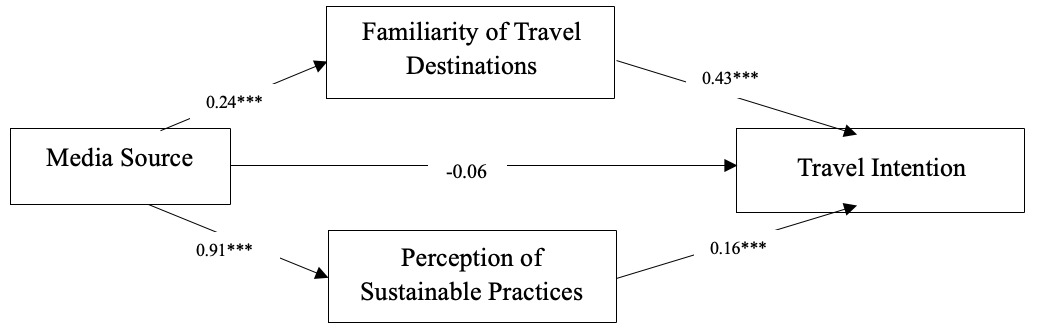
Tables 7 and 8 display the results for the test of mediation. Model 1 shows the positive effect of exposure to media sources on travel intention, B = 0.19, p < .001. Model 2a and Model 2b show the positive effects of exposure to media sources on the mediator 1 (i.e., familiarity of travel destinations), B = 0.24, p < .001, and mediator 2 (i.e., perception of sustainable practices, B = 0.91, p < .001. Lastly, Model 3 shows the positive effect of the two mediators, familiarity of travel destinations and perception of sustainable practices, on the travel intention, B = 0.43, p < .001, and B = 0.16, p < .001, respectively. Following Hayes’ (2022) PROCESS macro Model 4, we generated the bootstrap bias-corrected estimates of the indirect effects of the exposure to media sources on travel intention via the two mediators. The indirect effect is represented by the product of a and b, with ab1 as the indirect effect of familiarity of travel destination, and ab2 as the indirect effect of perception of sustainable practices. As shown in Table 8, both mediators had a significant effect on travel intention (ab1 =0.10, [0.66,0.14] and ab2 =0.15, [0.11, 0.96]). These results suggest that both familiarity of travel destinations and perception of sustainable practices mediated the relationship between exposure to media sources and travel intention. The path coefficients of the relevant variables are displayed in Figure 2. All regression coefficients were statistically significant, except for the direct effect of exposure to media sources on travel intention. These results suggest an “indirect-only” mediation (see, for example, Hayes, 2022; MacKinnon, 2008; Montoya & Hayes, 2017; Zhao et al., 2010), indicating that the total effect of media sources on travel intention was coursed through the two mediators: familiarity of travel destinations and perception of sustainable practices. Given the statistically significant indirect effects of media exposure on travel intentions through both mediators – familiarity of travel destinations and perception of the cities’ sustainable practices – we demonstrated that the observed data fit the hypothesized mediation model (see Figure 2 and Table 8). Therefore, media exposure may not directly motivate Filipino college students to travel, but it increases their willingness to do so as they become more familiar with travel destinations. Additionally, exposure to content that contains sustainable practices also enhances the perception of sustainability among these destinations. Together, these findings support the study’s conceptual argument that media exposure shapes travel intention by activating both cognitive familiarity and sustainability-related evaluations.
Discussion
The findings affirm and refine the destination image model by showing that media exposure shapes travel intention only when processed through cognitive pathways. In this study, familiarity with destinations and perceptions of sustainable practices both served as mediators, indicating that intention forms when students recognize a city and associate it with attributes they value. The findings frame perceived sustainability as an additional cognitive component of destination image rather than a separate promotional factor.
The results also introduce a cultural nuance: Filipino college students tend to link sustainability with technological advancement, suggesting that sustainability in emerging Asian contexts is interpreted through modernity cues and urban systems. The full mediation effect further clarifies that media does not directly drive intention but influences how young people evaluate destination attributes. These insights extend theoretical discussions on how destination images are constructed among digitally connected, sustainability-aware travelers.
Music has the strongest influence among Filipino college students in knowing more about Seoul. This can be considered a result of the Korean government’s effort to continuously promote K-pop and boost tourism in its cities (Moon, 2024). The same scenario is also evident in the destination image of cities in China. Chen et al. (2021) showed that seeing the film, Chinese Kung Fu positively enhanced the image of destinations, specifically in pursuing continued growth in tourism. Similarly, the student’s perception of Bali, Indonesia, aligns with the study of Suryawati (2021), as films were found to be an effective channel in promoting Bali through information published. This relationship reinforces how media content shapes the cognitive and affective components of destination image, which is central to the theoretical lens used in this study.
More of the respondents said that Seoul and Hong Kong were technological centers compared to other cities. It can be suggested, based on the study of Li et al. (2022), that technological centers also help boost urban sustainable practices, particularly in the environment, through the allocation of resources. The results added that most Filipino college students would most likely visit Seoul. It was mentioned in the study of Kim (2023) that Filipinos visit South Korea for tourism, and it was found that they prefer guided tours for shared experiences and security.
There is no relationship between media sources and the travel intention of the respondents to a city, which does not support the first hypothesis of this study. Anchored in the study by Pop et al. (2021), the consumption of social media content positively influences an individual’s choice of destinations to visit. This is also supported by a study conducted among tourists in Bali, Indonesia, mentioning that their decision to travel to Bali was influenced by their social media consumption (Rahjasa et al., 2024). It was also shown that exposure to media sources influences Filipino college students’ travel intention, specifically through their familiarity of travel destinations, supporting the second hypothesis. Similarly, Tan and Wu (2016) also found that among Taiwanese respondents, their familiarity with Hong Kong as a tourist destination, particularly the information they acquire from media and education, has an impact on their intention to travel there. These findings support the idea that familiarity serves as a key pathway in the destination image theory, where repeated exposure builds recognition and shapes the intention to visit.
Furthermore, it was found that media sources influence Filipino college students’ travel intention by their perception of sustainable practices, which supported the third hypothesis tested.
This provides further support to the claim of Conti et al. (2023) that students’ perception of sustainability of cities as tourist sites contributes to their intention to visit. Acuti et al. (2018) stated that media, specifically the content being published, may influence tourists’ attitudes toward the sustainability image of a city. On the other hand, it was revealed that there is a gap in how cities project their image to tourists compared to how it is being perceived. Cities, through organizations, project general sustainability topics; however, tourists tend to focus on environmental and socio-cultural conditions (Q. Chen et al., 2023). This supports the finding that perception of sustainable practices is a distinct mediator, since students respond not only to promotional narratives but to specific sustainability cues that they associate with responsible urban development.
Conclusion and Recommendations
The Filipino college students’ exposure to various media channels and their perception of sustainable practices have influenced their travel intention to these cities. It was also found that such exposure also helps in the projection of cities on their sustainable practices. Given these results of this study, it validates the flow of the destination image model (Agapito et al., 2013) based on the Filipino college students’ perceptions of the identified cities to their travel intention. This confirmation reflects how cognitive familiarity and sustainability cues work together in shaping destination image among young travelers.
This study concludes that these media channels not only serve as a source of information, but a consideration among the Filipino college students in choosing tourism destinations. It shows that in choosing these cities, they value sustainable and ethical efforts being made. From a tourism perspective, the findings highlight the need for cities to refine the selection of media channels that most effectively build familiarity and interest among young audiences. From a sustainability perspective, the results suggest that cities benefit from communicating clear and visible sustainability efforts that resonate with students’ expectations. Therefore, these findings may help cities push for tourism growth through increased marketing efforts, specifically in selecting media channels for advertising and promotions, and in highlighting their sustainability practices in place.
The researchers recommend further study, through a qualitative inquiry, on how Filipino college students perceive sustainability practices after visiting some of the identified cities. The findings may be compared to the results of this study and may serve as a basis for improving city practices and strategies. Future research could also explore how actual travel experiences shape or refine the perceptions identified in this study.
Authors’ note
The data for this study was sourced from the results of the Cross-Country Survey through the 2023 Asia Youth Survey Project. The researchers utilized the data collected from the Philippines for this correlational study on selected Asian cities.