
In the fast-growing digital world, social media and its role to facilitate communication and to inform has had a great impact that affects every aspect of life. It produces interesting discussions, especially about politics. There are studies addressing the interplay between public opinion and social media, but very few of these specifically address the role of political parties on social media. Political dynamics not only condition the reception of political issues by the public but also affect how public opinion is formed, changed, and mobilized by bursts of information-processing and easy access to information updated daily. (Daud, 2021; Diehl et al., 2016; Ishrat, 2023).
Leeper & Slothuus (2014) state that the emergence of public opinion is predominantly shaped by the interplay mechanism between political parties and the media even as a chain reaction occurs among individuals’ motivation, perception, and rationalization in receiving, interpreting, and transmitting information. Another such study (Ishrat, 2023) indicates that this manner of public opinion formation is connected to the theory of motivated reasoning, which is when individuals’ political preferences can influence their processing of political messages communicated by political parties on social network sites. This may affect how efficiently political parties can manipulate or influence public opinion for their political ends.
At present, political parties race with time to reap benefits from the impact of social media and digitalization. Partheymüller & Faas (2015) mentioned that information on social media is an advantage for smaller parties, since it gives them the opportunity to “pull” voters. In addition, Bloquet et al. (2022) findings reveal that new political parties and young politicians are most likely to utilize social media as they can quickly adapt to technology. Such digitization trends also fostered changes in the organization of parties, patterns of relations between party levels, and internal decision-making (Bloquet et al., 2022).
Digital media is making political participation cheaper (Steinberg, 2015), offering more equal access to people of different social conditions (Blumler & Coleman, 2009), and stimulating knowledge and political participation (Boulianne, 2009). Accordingly, digitization alters not just the ways in which political parties communicate, but also how public opinion is shaped and spread, and how it gets organized for collective action on digital platforms.
The relationship between social media and electoral politics has been widely studied. Previous studies have explored a variety of diverse areas, such as the use of political advertising to mobilize citizens (Chu et al., 2024; Haenschen, 2023; Llaudet, 2018), the role of social media in shaping individuals’ political understanding (Feezell et al., 2021; Haugsgjerd et al., 2023), social media use and political participation (Ohme, 2019; Theocharis et al., 2023; Valenzuela et al., 2019; Xenos et al., 2014), and political polarization in the digital realm (Beaufort, 2018; Hong & Kim, 2016; Marozzo & Bessi, 2017; Russell, 2020; Yarchi et al., 2021).
Under current conditions, social media is expected to become a healthy arena for public deliberation, where political parties, the public, and the media can interact on an equal footing to realize a participatory democratic system (Effing et al., 2011; Jennings et al., 2021; Rishel, 2011). However, in reality, the political dynamics in Indonesia show that social media can also be a tool for political mobilization that is prone to abuse through the spread of disinformation, black campaigns, and political agitation that can cloud the democratic atmosphere (Olmastroni, 2010). This shows the need for an in-depth study of the development of public opinion in political dynamics, especially in political parties, using social media to shape, maintain, and even direct public opinion on social media.
This study aims to describe the political dynamics, especially the role of political parties in shaping public opinion through social media in Indonesia, which is still very relevant and crucial. Thus, this study contributes to the field of political studies. The presence of public opinion in political party activities on social media provides the basis for an analysis that the digitization of political parties, especially on social media, is very important for political parties (Jacunski, 2018). Although the number of studies related to this area has increased, there has been no research analyzing how public opinion is formed in political dynamics, especially regarding the role of political parties on social media. This study provides new insights into the strategies of political parties in political dynamics and examines how opinions are formed on social media.
Literature Review
The Role of Political Parties in Elections and the Political System
A political party can be defined as “any political group that is present at an election and can place candidates for public office through elections” (Nwokora & Pelizzo, 2013). Political parties play an important role in mobilizing and distributing political power in a democratic process. They bridge the desires, dreams, and needs of the people and the government. Through the comments section on these tweets, political parties can shape public opinion by conveying their messages, policies, and vision to the public. Political parties also provide a stage for citizens who wish to be directly involved in political life, especially in general elections at a national or local level. They serve as a stage for candidates who promote specific approaches and agendas, allowing citizens to voice their support or rejection of these political visions through their right to vote. Political parties also participate in policy-making that mirrors the interests of different segments of society. They are a tool which citizens can use to battle for those issues that they hold dear or would like changed within the system of government. Therefore, political parties are conceived as not only political organizations but also representative agents of the people’s interest; they determine public opinion and serve as platforms for people’s involvement in politics (Kyrychenko & Davlyetova, 2020).
Munggaran (2023) explained that political parties are structured entities with members who share certain goals and values, focused on acquiring political power as a prerequisite for implementing the policies they advocate. They are important in inviting and guiding people to participate in political activities. One of the main functions of political parties is to provide political education to the community to increase a healthy understanding of political culture. To provide political education, political parties can collaborate with the community through various methods, such as political socialization, political education, and campaigns. The main goal is to understand better the political process, public policy, and the importance of active involvement in democracy.
Political parties play a very important role in drafting and communicating laws to achieve the vision and mission of the party, because political parties participate in the executive and legislative branches and their mechanisms, especially through political lobbying. Political parties are also interested in implementing policies in the form of control over government policies. Therefore, as the main political force, political parties have a role in shaping the political agenda, proposing laws, and ensuring that their vision and mission can be realized through the legislative process. They play a role in representing the interests and political views of the segments of society they represent (Syam, 2022).
Public Opinion in Political Party Dynamics on Social Media
Public opinion is particularly relevant to democratic political systems where direct elections are common due to the need for power holders to gain favorable impressions from citizens (Olmastroni, 2010). This aligns with the view that public opinion can also be understood as a form of control (Scheufle & Moy, 2000). Not only from above, where political elites act as parties who can influence public opinion (Leeper & Slothuus, 2014), but the growing opinion can be used as a source of drafting the necessary political measures (Erikson & Tedin, 2023; Stieglitz & Dang-Xuan, 2013).
Contemporary developments show remarkable results where public opinion research can be conducted through social media conversations. Previous research has shown that social media use, in general, can lead to increased online political expression and increased online and offline political participation (Gil de Zúñiga et al., 2014). Some parties use social media to have their opinions heard and/or to influence the political agenda and public opinion (Bennett & Segerberg, 2012; Dubois et al., 2018)
Research Method
The method used in this study was qualitative using content analysis. This study collected data using Twitter (now known as X) data obtained from the Twitter Streaming Application Programming Interface (API) (Lai et al., 2017). Twitter data is retrieved through the Python Application, which is useful for seeing communication patterns and community responses to the dynamics of political parties in the digitalization era. Information data from Twitter has been widely used as a tool to understand public interest across regions, both in the spatial and time dimensions (Zhao et al., 2011). Various online platforms, including Twitter, have provided Application Programming Interface (API) as a communication channel between developers and users. This allows systematic access to large data loads. Public opinion is observed on the dynamics of political parties using the Twitter streaming API application, so analysis data is collected through the API.
The data analysis used in this study is content analysis and sentiment analysis to describe public opinion in political dynamics, especially the role of political parties on social media in Indonesia. Rathore et al. (2017) reviewed social media analytics and concluded that Twitter dominates as the most popular social media application due to the ease of data extraction. Their findings align with our results, where 33 of the 54 studies we selected used Twitter as a data source to gather public opinion. Flores and Rezende (2018) emphasized that Twitter has also become popular in the context of opinions related to government issues. Therefore, Twitter is an effective channel to understand people’s feelings and viewpoints on current news headlines from a global perspective.
In addition, in retrieving English conversation data (tweets) about political parties using a Python application called Tweepy and the Twitter Streaming API, this research uses keywords with the names of political parties (e.g. Nasdem), PAN Party, Buruh Party, Gelora Party, Gerindra Party, Perindo Party, Ummat Party, PDIP, PKB Party, PKS Party, PPP Party, PSI Party, Demokrat Party. We use the names of parties categorized as old parties and new parties based on their registration period from October 2022 to December 2022. This period is the registration period for parties in the 2024 elections. We collected conversation data over a three-month period, from October 2022 to December 2022, when political parties were registering to participate in the 2024 elections in Indonesia. The collected information was stored in JSON for ease of parsing and analysis. We then performed a data cleaning process to remove some types of information, such as URLs and hashtags, which would not be included in the analysis.
This research uses content analysis (Krippendorff, 2019) and sentiment analysis with the data already collected (Camacho et al., 2021). A qualitative content analysis was performed in order to classify each communication pattern/exposure manner (similarly used during the classification of data such as conversations) for further analysis (Malekahmadi et al., 2023; Wheeler, 2023). Sentiment analysis also aims to enrich the analysis of political party dynamics (friction and cooperation) among old and new parties. The sentiment analysis can be obtained from review data, such as ratings, sentiments, behaviors, and emotions, which are expressed using text. To detect sentiment, the author employs RStudio and the NFC (narrative fiction corpus) library. NFC is a corpus that comprises several literary texts, but on which some information about the structure and the content of these texts (characters, events, and themes discussed in the text) has been addressed (Fasulo & Zucchermaglio, 2008).
Results and Discussion
Findings
The tweet data was collected over three months, from October to December 2022. It covers public engagement with the various political parties involved in the conversation on Twitter. During the data collection period, 450,328 tweets were processed, covering the activities of various political parties. This is a large enough sample to capture the political conversation on social media during this time.
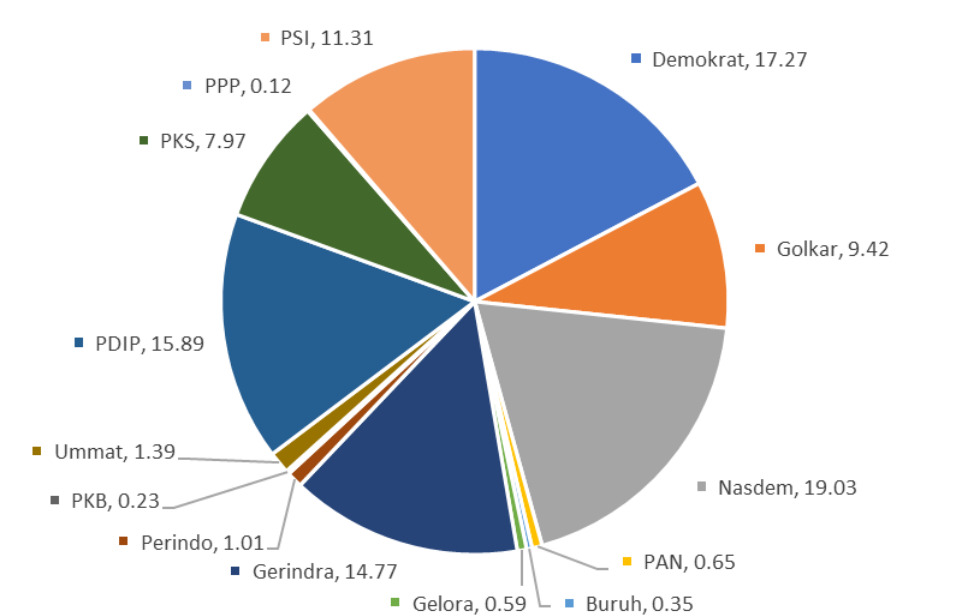
This study found a significant difference in the number of tweets associated with old parties compared to new parties. Old parties were founded before and participated in elections before 2024. The old parties include Demokrat, Gerindra, Golkar, Nasdem, PAN, PDIP, Perindo, PKB, PKS, PPP, and PSI. Meanwhile, the new parties include Buruh, Gelora, and Ummat.
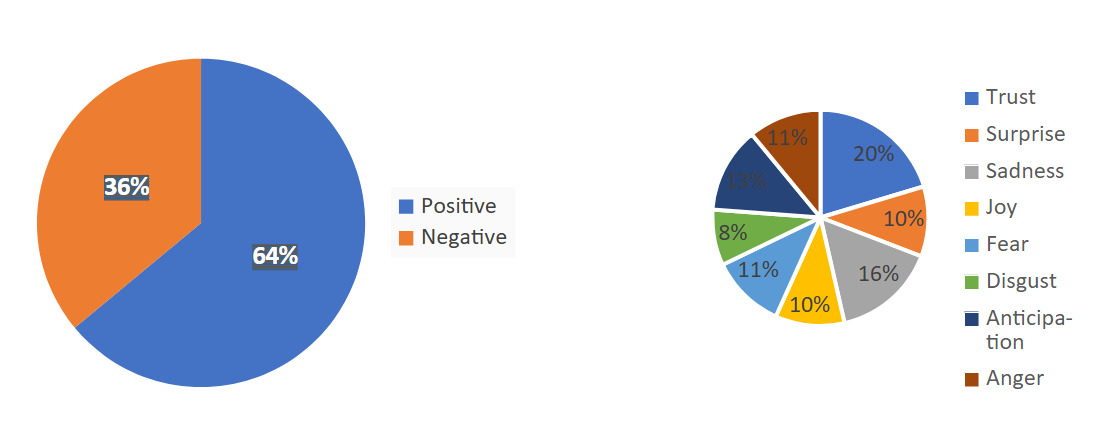
To determine sentiment and emotion results, the existing comment data in tweets is classified into positive and negative categories consisting of trust, surprise, sadness, joy, fear, and disgust. This study utilized computational methods because 450,328 tweets were successfully collected, as suggested by (Krippendorff, 2019).
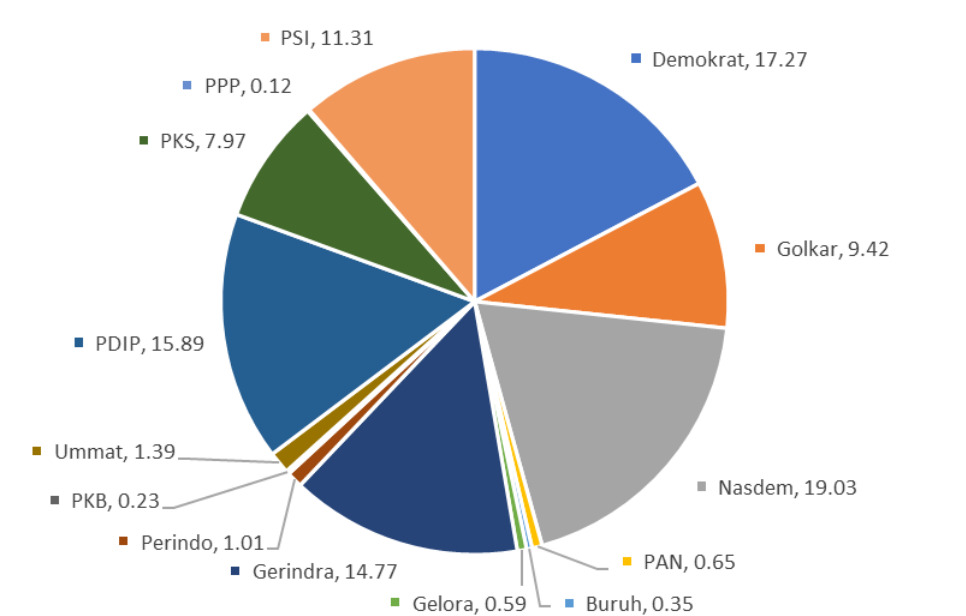
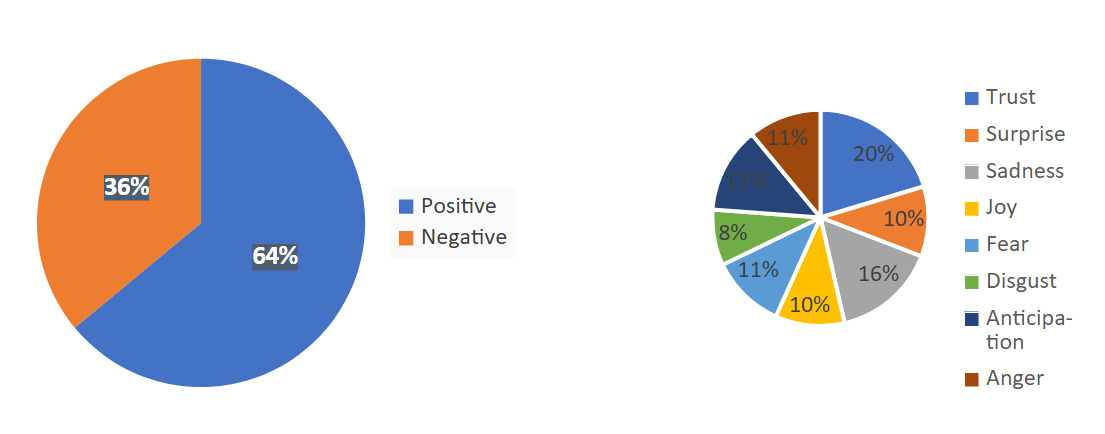
The grouping of emotions shown in the graph (right-hand side) shows the dominance of trust (20%) compared to other emotions. However, sadness towards political parties is quite high, reaching 16%. The next emotions in order are anticipation (13%), fear (11%), anger (11%), surprise (10%), excitement (10%), and disgust (8%). Nonetheless, the general number of sentiments and emotions does not represent public sentiment towards specific political parties. There are significant differences in sentiment between political parties. Most of the conversations collected in this study (see Figure 2) revolve around five political parties: Nasdem (around 19%), Demokrat (around 17%), PDIP (around 15%), Gerindra (around 15%), and PSI (around 11%). All of these parties are old parties.
Meanwhile, other political parties, including new ones, were not much discussed in the conversation: the two old parties, Golkar and PKS, accounted for about 9% and 8%, respectively. The rest, including all new parties, are only about 1%.
According to the table with total tweets, not all parties have an interest in managing political issues on Twitter. The parties of NasDem, the PDIP, Demokrat, and Gerindra have high intensity on posts representing more serious actors using social media to shape and manage public ideas or beliefs as seen through the sheer amount of other posts in comparison with response shares for certain tweets. The high number of tweets suggests enduring activity in the framing and attention-contesting efforts from time to time, while the number of likes indicates the success of the party to become a focal point and resonate on issues for Twitter users. In contrast, parties that have low social media posting intensity and like rates (PPP, PKB, PAN, Gelora, and Buruh) are less involved in issue management through their posting on social media; hence their impact on public perception tends to be smaller. These results confirm that political parties’ issue management on Twitter is strategic and uneven, with high-intensity, high engagement parties the most interested and active in shaping and redirecting public attention in digital media.
Based on an analysis of social media posts, there is significant support from several political parties for Anies Baswedan’s candidacy as president in the 2024 presidential election. The Demokrat Party, through the posts of its party elite Andi Arief (@Andiarief_), showed efforts to explore Anies’ candidacy with other political parties. The Democratic Party’s support is also evident from the presence of party elites in a lunch with Anies, as posted by @jansen_jsp. The Nasdem Party (Nasdem) openly expressed its support for Anies, with a post from the official @NasDem account that reported Anies’ planned visit to Aceh as a presidential candidate carried by the party. Nasdem elites were also seen having lunch with Anies in the same post. Support from the Prosperous Justice Party (PKS) is reflected in the presence of party elites at lunch with Anies. At the same time, the United Development Party (PPP) officially declared its support through a post from @abwnewsco showing PPP Banda Aceh’s stance.
Although there has been no official statement, there are indications of support for Anies from the National Mandate Party (PAN). This can be seen from @AdindaZahrany07’s post, which states his hope that PAN will support Anies in the 2024 presidential election. However, it should be noted that this post is a personal opinion and does not represent the party’s official stance. On the other hand, the Gerindra Party showed a critical attitude towards Anies through its politician Andre Rosiade’s statement quoted by @CttnDmkrs. This shows complex and diverse political dynamics related to Anies’ presidential candidacy.
These patterns and themes show that old parties do concentrate on the dynamics of presidential candidacy, especially regarding Anies Baswedan, coalition strategy. and party positioning toward the 2024 presidential elections. There are also efforts to denounce the government and debate party tactics.
Twitter posts for emerging political parties in Indonesia revealed some interesting patterns and themes. One recurring focus is the inconsistency or contradiction of new party positions. The effect can be seen in a @BukuProgresif post that asks how the Buruh Party could bring themselves to back the Job Creation Law, which is undeniably pro-employer and was previously deemed unconstitutional. Such as the buruh party picture of pro-consumer vs actual policy support and how their views have been perceived by the public.
Another popular topic was the debate about whether or not the Election Commission (KPU) should validate new parties. A tweet from the @ZAEffendy account, which used Tempo’s reported content, said the Gelora Party and two other parties’ losses in examining political parties were based on the central KPU’s direction to the regional KPU. This has brought the independence and integrity of the political party verification process by the election body into question.
Moreover, the study also highlights how new parties try to secure vote share in public. It is clear in the post of account @BosPurwa, which directly recruits the public to support or approve KPU to accept Ummat Party as an election participant. This post shows how new parties were strategically using social media to construct support and establish themselves within the political arena.
Sentiments and Emotions on Political Party
Analyzing sentiment and emotions toward political parties in Indonesia shows interesting variations. Generally, most political parties in Indonesia have higher positive than negative sentiments. The average positive sentiment for all parties is 64%, while the negative sentiment is 36%. This shows that public perception on social media Twitter tends to be more positive towards political parties.
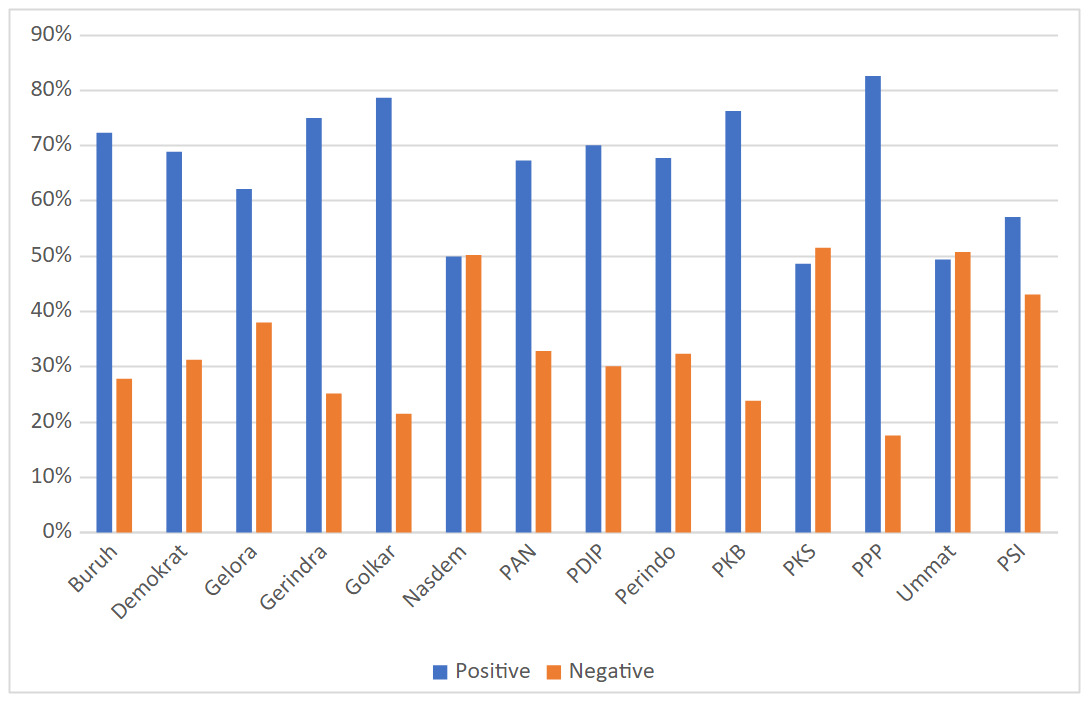
However, looking into the old and new party clusters in more detail, we will see some interesting differences. The old party cluster consisting of Demokrat, Gerindra, Golkar, Nasdem, PAN, PDIP, Perindo, PKB, PKS, PPP, and PSI has an average positive sentiment of 67% and negative sentiment of 33%. This is slightly higher than the overall average. Some parties that stand out with high positive sentiment are PPP (83%), Golkar (79%), and PKB (76%). Meanwhile, PKS and Nasdem have balanced positive and negative sentiments (49% vs 51% and 50% vs 50%). Negative emotions such as fear, disgust, and anger also tend to be lower. This suggests that older parties generally receive more positive emotional responses. This aligns with the tweet analysis, which shows that the old parties, such as Demokrat, Nasdem, PKS, and PPP, tend to support Anies Baswedan’s candidacy for president.
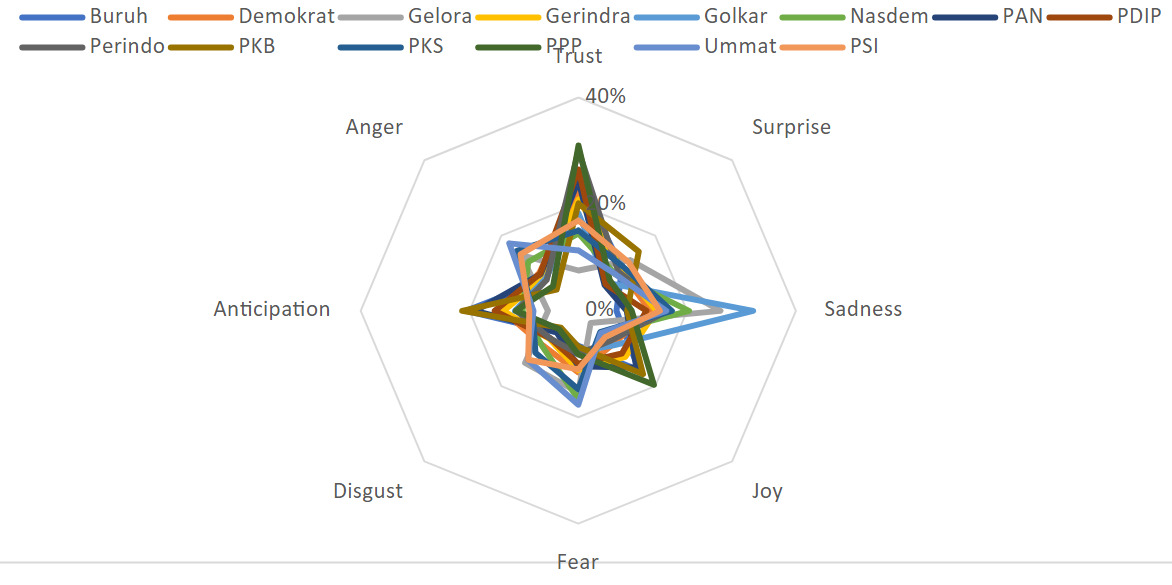
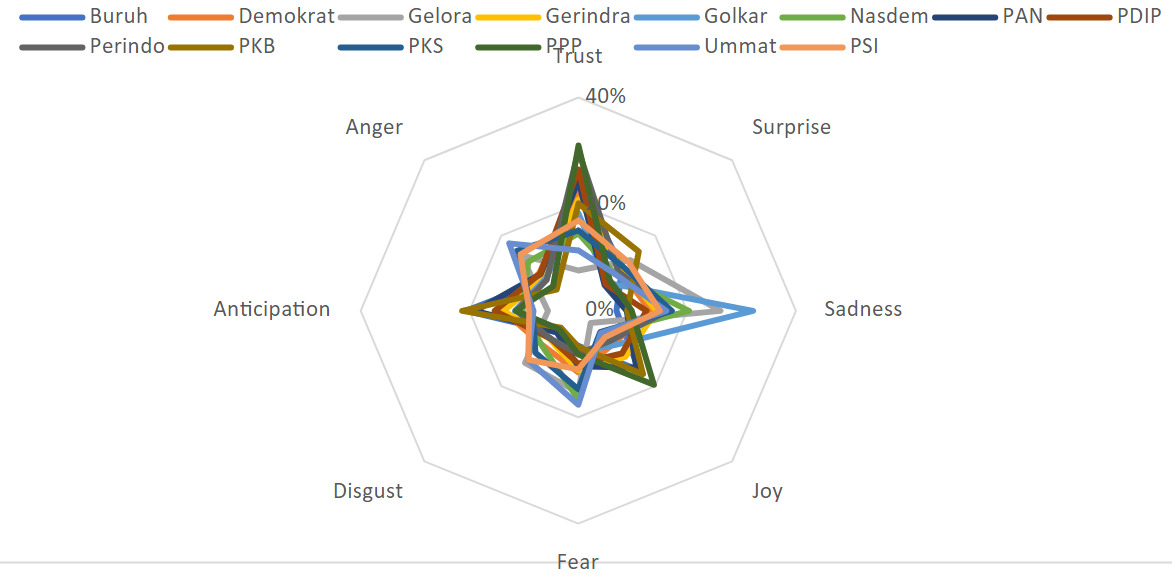
Meanwhile, the new party cluster consisting of the Buruh, Gelora, and Ummat Parties has an average positive sentiment of 61% and a negative sentiment of 39%. This figure is slightly lower than the overall average and the old party cluster. Buruh party has the highest positive sentiment (72%), while Gelora and Ummat have almost equal positive and negative sentiments. In terms of emotions, this cluster has higher levels of sadness (16%), fear (13%), disgust (11%), and anger (14%) than the old party cluster. Meanwhile, trust (14%) and anticipation (11%) are lower. This indicates that new parties tend to get more negative emotional responses. This may be influenced by the attitudes of some new parties that trigger negative views from the public, such as the Buruh Party’s support for the Job Creation Law (Omnibus Law) and the alleged power intervention in the passing of the Gelora Party at the factual verification stage of new parties.
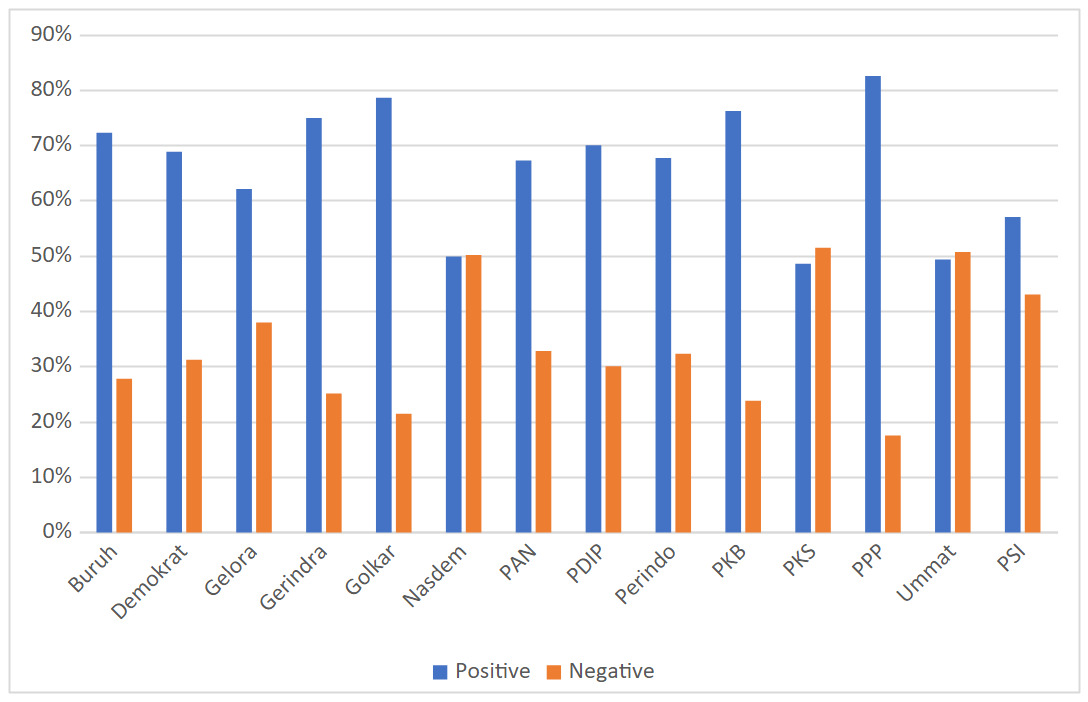
These emotion and sentiment patterns are important enough for political parties in crafting their communication strategy and positioning accordingly. Positive and high-trust sentiment parties, i.e., PPP and Gerindra, could keep or increase their positive image. At the same time, parties with negative sentiment problems or high negativity need to improve their image. This information shows the complex emotions in Indonesian politics as trust, positive surprises, and thoughtful management of negative perceptions are key for solid political party engagement with the public.
Discussion
Research findings show that public opinion in political dynamics, particularly regarding the role of political parties on social media, forms an interactive and competitive arena in which parties actively seek to influence and manage public perception. This study utilizes data collected from a number of exchanges on Twitter between October and December 2022 to suggest that political parties can influence various political voices on social media. The difference in the number of tweets indicates the level of power each political party has in exposing sentiment on social media. Parties with very high posting intensity, such as NasDem, Demokrat, PDIP, and Gerindra, are very active on Twitter in packaging issues, strengthening political narratives, and maintaining their party’s visibility amid increasingly intense political dynamics ahead of the 2024 elections. The volume of tweets from these parties shows that they use Twitter not only as a channel to disseminate information, but also to strategically shape public opinion over time.
On the other hand, parties with a low to very posting intensity (PPP, PKB, Buruh, Gelora, and PAN) have less engagement in managing issues through their Twitter activities. The small number of tweets may be indicative as a limitation in digital communication strategy but it might also mean that there is preference for not using social media as the platform for this material. Yet this also means low exposure of party stories in digital public spheres, which may limit their impact on public opinion. These results underpin the claim that the control of public opinion by political parties is an active process and demands high intensity and well-structured communication activity over social media.
In addition, there are differences between political parties in terms of emotions, such as sadness towards Golkar, joy towards PKB, and fear and anxiety towards PKS, Ummat, and Gelora, which show that public opinion towards political parties is actually very dynamic, with high sensitivity to changes in public opinion on social media. The diversity of sentiments, such as anger, which depends on these factors, is in line with the idea that public opinion functions as a social control mechanism in a democracy, where politicians are involved in building an acceptable self-image to gain political legitimacy (Olmastroni, 2010). Public opinion on social media is also in line with Scheufle and Moy’s (2000) view of how public opinion acts as a controlling force on the behavior of political elites.
At the same time, there is a marked difference between established and new parties in terms of social media engagement. The established parties are represented as Nasdem, Demokrat, PDIP, Gerindra and PSI, which dominated the conversation (with more than a combined 75% of the analyzed tweets). This domination further supports the past finding of entrenched position of established parties in Indonesian politics (Aspinall & Berenschot, 2019). These groups are well-engaged because they already maximize the use of social media as a venue for political communication, which has seen a significant rise in importance (Tapsell, 2015).
However, the relatively low engagement of new parties such as Buruh, Gelora, and Ummat raises questions about the challenges emerging political entities face in gaining traction in the digital realm. This gap could be due to limited resources, a less established supporter base, or difficulties differentiating themselves in a crowded political landscape (Mietzner, 2020).
In addition, sentiment analysis shows that political parties are generally viewed positively (an average of 64% positive sentiment across all parties). This result is somewhat surprising given that political content shared on social media platforms is often critical (Lim, 2025). The higher positive sentiment for established parties (67%) compared to new parties (61%) indicates that although they may be less favored, they have better brand visibility and more loyal supporters. There is a more subtle emotional calculation at play here. The high prevalence of trust and anticipation in emotions associated with established parties indicates public confidence in these political entities. This is consistent with findings that, despite facing difficulties and resistance, traditional parties in Indonesia still enjoy significant popular support (Aspinall & Warburton, 2018).
On the other hand, higher levels of negative emotions (sadness, fear, disgust, and anger) towards new parties indicate the potential difficulties that new parties may face in building a positive public image. This emotional map may reflect a general lack of public acceptance of new political actors, based on eroded trust in previous political reform efforts in Indonesia (Mietzner, 2014).
These results show the influence of presidential candidates, particularly Anies Baswedan, Prabowo Subianto, and Ganjar Pranowo, on party image, as well as the viral effect on social media. Positive sentiment towards these parties is likely driven by the support given to presidential candidates from parties such as the Demokrat, Nasdem, PDI, and Gerindra. This highlights the personalized nature of Indonesian politics, where figures often dominate party programs (Aspinall & Mietzner, 2019). This case is an example of how a figure can function as a node for party realignment and public debate. This development shows that personal charisma still plays a critical role in Indonesian politics, which has emerged since its democratic transition (Aspinall, 2015).
Analysis shows that new parties face significant challenges in rising through the ranks in Indonesia’s political environment. Disputes over the verification process for new parties, such as in the case of the Gelora Party, reflect the systemic obstacles that new political organizations may face. This situation raises doubts about the openness and competitiveness of Indonesia’s party system, a fact that has not escaped the attention of Indonesian political observers (Tomsa & Setijadi, 2018).
In addition, new parties can increase positive public opinion toward their party on social media with populist issues, such as the position taken by Buruh Party on labor issues, indicating that new parties are likely to find it difficult to define their identity and maintain voter confidence. This phenomenon is not specific to Indonesia and can also be found in other new democracies where young parties struggle to develop their ideological identities (Ufen, 2008).
These findings have serious implications for the direction of Indonesian democracy. Social media appears to be dominated by established parties, indicating stability in the party system. However, the difficulty for new parties to make an impact in politics also hinders political innovation and responsiveness to changing social concerns (Mietzner, 2020).
An overall positive attitude towards political parties, especially the old ones, reflects trust in the political system. This is part of the continuity and legitimacy of democracy (Diamond, 2015). However, the fact that new parties are associated with more negative emotion than established parties indicates the need for new parties to provide digital-based communication strategies on social media to increase positive sentiment in the digital public sphere (Hadiz, 2016).
Conclusion
Established political parties and new parties have a significant gap in terms of public engagement with society, especially from a social media perspective. Nasdem, Demokrat, PDIP Gerindra, and PSI, as well as several other parties that actively use social media for two-way conversations, show that some of the established parties are able to influence political views digitally during campaigns. On the other hand, new parties such as Buruh, Gelora, and Ummat find it difficult to introduce themselves and win the trust of the public. Sentiment analysis shows positive sentiment towards political parties in general, and more positive sentiment towards established parties compared to new parties. These results highlight the role of individuals or figures, including presidential candidates such as Anies Baswedan, Probowo Subianto, and Ganjar Pranowo, in shaping public opinion and party affiliation on social media mostly supported by established parties.
This research contributes significantly to the development of democracy in Indonesia. The dominance of established parties in social media conversations indicates the stability of the party system, but also has the potential to hinder political innovation and responsiveness to new issues. Although positive feelings towards political parties signify a high level of public trust in the political system, greater negative emotions towards new parties indicate possible frustration, which could open the door to populist or anti-establishment sentiment. To develop future research, this study recommends a longer duration. Data should be compared across a broader collection of social media platforms and over time. This will contribute to a more complete and in-depth understanding of the dynamics of political parties in Indonesia, particularly trends and shifts in public attitudes towards political parties over time.