
Over the past decade Kazakhstan’s media landscape has undergone rapid change. Traditional broadcasters continue to dominate the television sector, yet they now rely heavily on online platforms to retain relevance among increasingly digital-first audiences. Internet penetration reached over 92% by 2024, and more than two-thirds of the population are active social media users, with YouTube occupying a central position in everyday information consumption (Kemp, 2024). This structural transformation has created a hybrid media environment in which state-owned and private broadcasters coexist with citizen-driven production. Cultural and political factors, including language policy, identity debates, and digitalization strategies, shape content circulation and audience engagement. Television documentaries are no longer confined to broadcast schedules but increasingly circulate on YouTube. There, they stimulate discussions in comment sections and become part of broader social conversations.
Scholarship on Kazakhstan’s audiovisual sector demonstrates that documentaries function not merely as cultural products but also as instruments of civic dialogue. Pshenaeva (2024) highlighted that the production of high-quality audiovisual narratives plays a significant role in shaping collective values. Building on this, Asyltaeva and Nurov (2024) highlighted the role of media in cultivating civic identity, suggesting that documentaries, when distributed through online platforms, can act as resources for national self-reflection. At the same time, studies of the institutional side of broadcasting emphasize the challenges of adapting traditional television to a platform environment. Moldabayev and Mehmet (2020) showed how regional channels struggled to adjust to digital demands, pointing to structural barriers and opportunities for integration.
The social dimension of platform communication has also been examined. Togtarbay et al. (2024) studied citizen journalism on social networks, demonstrating how online environments enable alternative voices and facilitate active participation in public affairs. Similarly, Sadirova and Abdirova (2020) revealed how ideological discourses migrate to platforms such as YouTube, reinforcing that online comment spaces are venues of political meaning-making rather than neutral arenas of entertainment. In parallel, Manakbaeva (2022) linked film production with national pride, showing that the cinematic medium can stimulate expressions of cultural attachment and collective belonging.
Despite significant progress, three main gaps remain in the scholarship. First, Kazakhstani studies usually examine documentaries from the perspective of production quality, institutional adaptation, or broad media functions, but seldom address how audience conversations unfold in digital comment spaces. Second, cross-channel comparative studies are limited: we lack evidence of how different broadcasters’ strategies on YouTube shape conversational intensity and thematic diversity. Third, existing work often frames media as influencing public opinion but does not adequately capture the descriptive and discursive structures of online interaction. That is, it fails to explain how audiences themselves articulate meanings, identities, and critiques through comments.
The study aims to analyze how documentaries distributed on Kazakh broadcasters’ official YouTube channels stimulate and structure social conversations within the platform environment. To achieve this goal, the following tasks need to be solved: study the current state of television and online platforms in Kazakhstan; analyze the interaction between traditional television and social media; assess the impact of documentaries on social conversations and discourse on YouTube; study the nature of social conversations on YouTube: comments, discussions, audience reactions; compare social conversations around documentaries.
Research Methodology
The main television channels of Kazakhstan were selected for the study: Channel One Eurasia, KTK, Qazaqstan, Astana TV, NTC, Mir, Channel 31, Channel 7, Khabar, Balapan (available through various digital platforms, namely through their official websites and mobile applications). These channels cover a large part of the country’s population have a diverse audience and are involved in the creation and distribution of content such as documentaries.
Data were collected by analyzing the ratings of TV channels presented on the website of the National Media Association of Kazakhstan for the period from July 1, 2023 to December 31, 2023. Additional data were obtained from official sources, such as Digital 2024: Kazakhstan (2024) (annually measured indicators of digitalization, Internet access, and use of the social platform YouTube), channel websites, YouTube channels, as well as through viewing documentaries posted on these platforms. For this purpose, the average number of views, likes, and comments on documentaries were analyzed.
The focus was on documentaries of social significance, which met the following inclusion criteria: (1) officially uploaded to the YouTube channels of Qazaqstan TV and Jibek Joly TV; (2) clearly designated as “documentary” by the channel; (3) minimum duration of 10 minutes; (4) thematic orientation towards socially relevant topics such as poverty, culture, family, history, national identity, and ecology. Exclusion criteria were short videos, trailers, news reports, talk shows, or videos where comments were disabled. This ensured the comparability of films and allowed patterns in social conversations about similar types of documentaries to be identified. Social discussions on YouTube and other platforms were also considered.
The research procedure included data collection, analysis of social discussions, and measurement of approval and engagement. Data on views, likes, comments, and subscribers of the Qazaqstan TV and Jibek Joly TV channels were collected for the period from June 2023 to June 2024 using VidIQ online tools and official sources. VidIQ is a YouTube analytics tool that provides quantitative indicators of audience engagement and content performance, including views, likes, comments, and subscriber dynamics. The classification was based on categories established in previous studies of online audience engagement (Burgess & Green, 2011; Chattoo, 2020). This approach ensured the content validity of the analytical framework. A quantitative content analysis approach was applied to examine the nature and structure of social conversations around documentaries. The approval rate was calculated as the ratio of the average number of likes to the average number of views, expressed as a percentage, using the formula (1):
ApprovalRate=Average number of likesAverage number of views∗100
The engagement rate was calculated as the ratio of the sum of the average number of likes and the average number of comments to the average number of views, expressed in percent, using the formula (2):
EngagementRate=Average number of likes+Average number of commentsAverage number of views∗100
The analysis focuses on “likes” as a positive engagement indicator because they represent explicit approval behavior. On YouTube, “dislikes” function differently: they may signal disagreement, political positioning, controversy, or algorithmic interaction rather than simple negative evaluation. Moreover, since November 2021, YouTube has hidden public dislike counts from viewers, which limits their reliability and comparability across time and channels. For these reasons, “likes” were operationalized as a standardized and publicly verifiable proxy for approval, while engagement was treated separately as a broader interaction construct. Nevertheless, the exclusion of dislikes is acknowledged as a limitation, as they may represent an alternative dimension of audience response.
Concerning the treatment of users who both liked and commented. The unit of analysis in this study is interaction events rather than unique users. Consequently, likes and comments were treated as distinct engagement actions. In the calculation of the engagement rate, both metrics were aggregated because they reflect different levels of audience involvement: liking represents low-effort interaction, while commenting reflects higher cognitive and emotional investment. Therefore, if a viewer both liked and commented, these were counted as two separate interaction events. The study does not attempt to identify or deduplicate individual users, as such data are not available through public analytics tools. This approach is consistent with established quantitative engagement metrics in digital media research.
The popularity rate of content on YouTube was determined using the average number of views per subscriber using the formula (3):
PopularityRate=Average number of viewsNumber of subscribers∗100
For data collection and analysis, VidIQ software, official YouTube analytical tools, and Excel were used to process statistics and build graphs. The main limitation of the study is that the data were collected only from open sources and may not fully capture audience views on platforms or channels that are not actively represented on YouTube. In addition, social discussions on YouTube may not fully reflect the sentiment of the entire audience due to the limited sample of comments.
The methodology used provides a systematic approach to analyzing the patterns of social conversations around documentaries in the digital age on the example of Kazakh television channels and their presence on online platforms.
Results
Television in Kazakhstan remains one of the key sources of information for a large part of the population. Major television channels such as TV Khabar, EM Kazakhstan, Channel 31, Eurasian Channel, and EM KTK continue to play an important role in shaping public opinion and providing entertainment content. These channels have a large audience and considerable influence, which allows them to remain in the spotlight of the media space. According to the National Media Association of Kazakhstan (2024), the ten most popular channels include the permanent leaders of the country’s TV airwaves. These leaders are Channel One Eurasia, KTK, and the national TV channel Qazaqstan, with a combined market share of over 40%. Other highly ranked channels include NTC, Astana TV, Mir, Channel 31, Channel 7, Khabar, and Balapan.
The variety of TV channels also affects the variety of content produced. According to the National Media Association of Kazakhstan, TV series and feature films are the most popular, followed by news, and the national singing competition Qazaqstan Dauysy on Qazaqstan TV channel (the average rating for the 47 episodes aired at the time of the assessment was 1.22%). Documentaries are also popular. According to the National Media Association of Kazakhstan (2024), the best documentary was the film Hearth of Death (Channel One Eurasia, October 29, 2023, and later broadcast on other national channels), which tells the story of the tragic accident at the Kostenko mine (Table 1).
State-owned media, such as TV Khabar and Qazaqstan TV, play an integral role in Kazakhstan’s information space, supporting government policy and reinforcing the official agenda. Documentaries such as “Hearth of Death” (Channel One Eurasia, October 29, 2023) illustrate how state-affiliated themes can attract substantial attention. At the same time, younger audiences increasingly prefer online platforms, which pushes TV channels to adapt their distribution strategies and integrate content with the Internet (Zabirova, 2025). With the increasing availability of the Internet, online platforms and social media have become an integral part of media consumption in Kazakhstan. In particular, platforms such as YouTube, Instagram, and Facebook have become central to everyday media consumption, especially among younger users. These platforms offer users a wide range of content, including news, entertainment videos, educational materials, and documentaries. Conversely, private channels, including KTK and Channel 31, have gained popularity by catering to diverse tastes and producing more varied content. These channels, along with independent media and online platforms, are contributing to a dynamic shift in Kazakhstan’s media landscape, driven by increasing digitalization and the growing preference for online content among younger audiences.
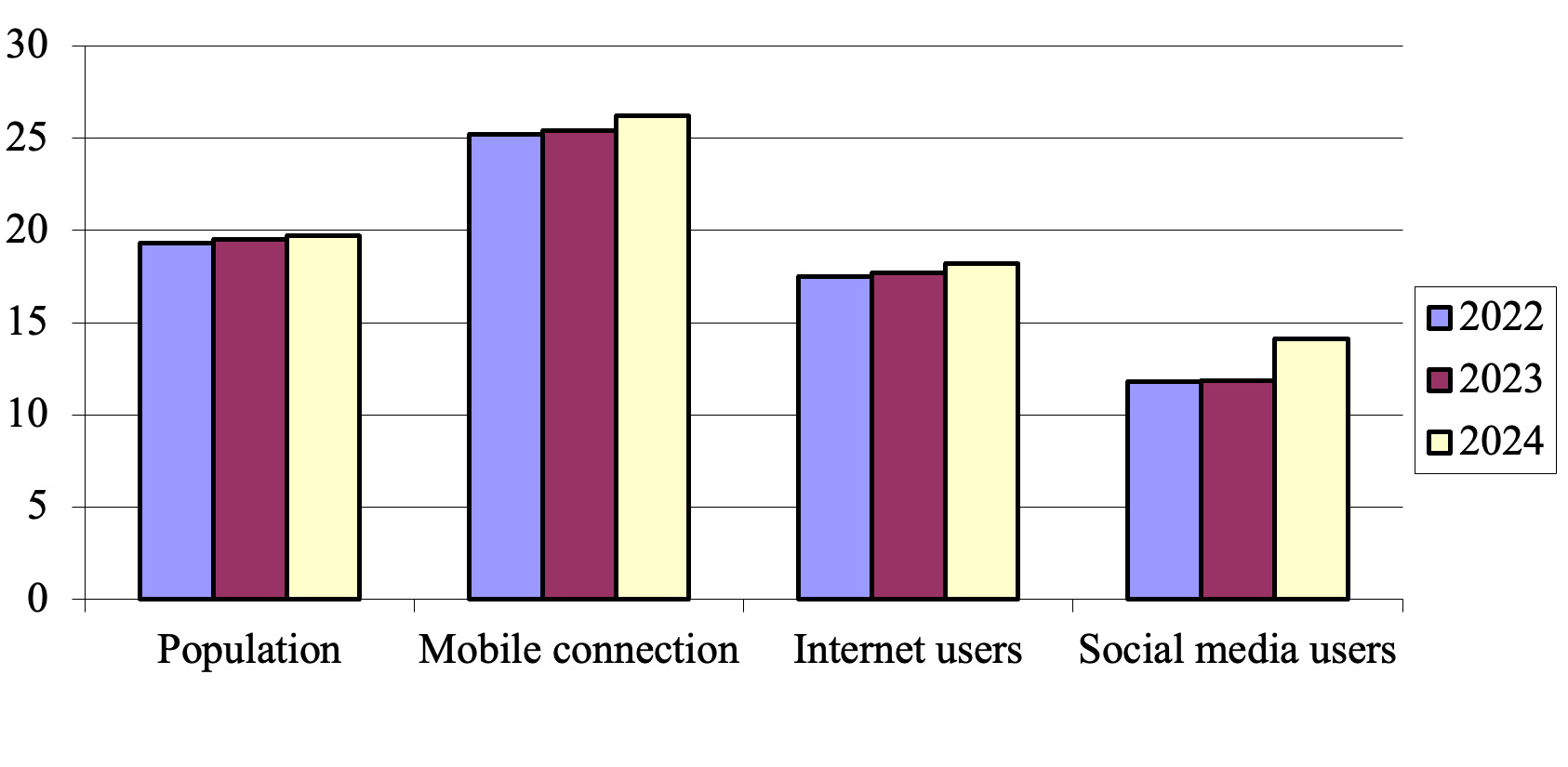
According to Digital 2024: Kazakhstan (2024), out of 19.71 million people in the total population of Kazakhstan (as of January 2024), 18.19 million are active Internet users, and the country’s Internet penetration rate was 92.3% of the total population. Figure 1 shows the level of digitalization of the population in 2022-2024, which is a strong indication of the active use of Internet access and social media.
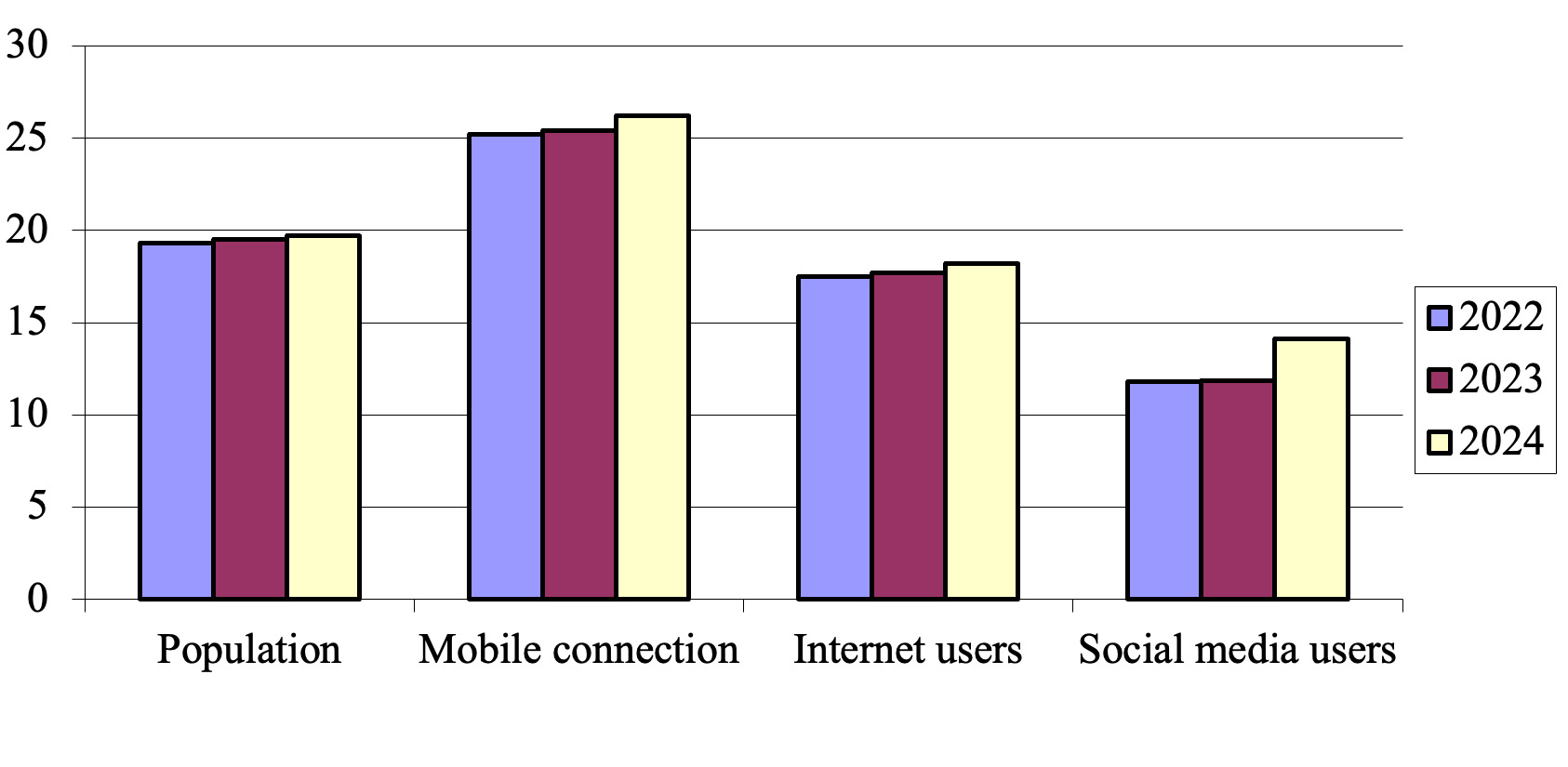
Over a period of 10 years (2014-2024), the number of Internet users grew from 10.9 million to 18.19 million, which is a strong enough argument to assess the impact of the Internet and social media on the population of Kazakhstan. In January 2024, there were 14.1 million social media users in Kazakhstan, equivalent to 71.5% of the total population (with an increase of 3.7 million per year). Table 2 shows the distribution of users according to the popularity of each social network.
The graph shows the fact that YouTube is in the top three (second place) among the most popular websites and social networks (18.4%). In other words, the results indicate that television channels have a strong need to maintain an active presence on the Internet. Online platforms provide users with the opportunity not only to consume content but also to actively participate in its creation and distribution. This opens new opportunities for interaction and exchange of opinions, which significantly expands the horizons of the media space (Baym, 2021; Luttrell & Wallace, 2021).
In response to the growing popularity of online platforms, traditional television channels have begun to actively integrate their services with the Internet. Many Kazakh TV channels have created their channels on YouTube and other platforms, where they post recordings of their programs, documentaries, and exclusive content. For example, TV Khabar actively uses YouTube to distribute its news and documentary programs, which allows it to attract a younger audience and increase its popularity online. It also allows TV channels to interact more directly with the audience, receiving feedback through comments and discussions under videos. Independent authors and bloggers actively use YouTube and other social media to create documentaries and analytical programs, often addressing sensitive social and political issues. As a result, online platforms foster broader public discussions and expand access to diverse sources of information.
In the documentary ranking presented in Table 1, Channel One Eurasia accounts for most of the entries (8 out of 10). At first glance, this would make it the most logical case for further YouTube-based analysis. However, its YouTube channel (“Main News of Kazakhstan / Басты жаңалықтар”) does not contain documentary content. A similar limitation applies to KTK, whose YouTube channel also does not provide a comparable documentary segment. Therefore, the analysis focuses on broadcasters with a clearly represented documentary output on YouTube: Qazaqstan TV (3.27 million subscribers) and Jibek Joly TV (616,000 subscribers and more than 73,000 uploaded videos) (Table 3).
The film about Akim Tarazi (which is the pen name of Akim Urtaevich Ashimov, 1933–2025, a prominent Kazakh writer, playwright, and screenwriter, and State Prize laureate of the Republic of Kazakhstan) had the lowest rating among the above films, and the film about the cultural heritage of the Kazakhs (in this case, about a breed of dog, the Tazy, also known as the Kazakh Greyhound, presented in the context of the history of Kazakhstan) had the highest rating. In general, it is documentaries about the culture, traditions, and history of Kazakhstan that have the highest viewership and social interaction rates among the audience. The Qazaqstan channel itself is constantly experimenting with the themes and forms of documentaries, releasing them regularly on television, social media, and YouTube (Zlenko & Dudar, 2024). During the analyzed period, the channel released an average of 1-2 videos consistently every month, which is a high indicator of both the channel’s productivity and the demand for such a product by the audience.
For comparison, Jibek Joly TV, a TV channel that is not so popular among TV viewers but is quite popular on YouTube (616,000 subscribers), with more than 73,000 videos and a separate podcast segment on various topics, was selected. The channel broadcasts around the clock, and its programs cover several thematic areas, covering such areas as culture, traditions, and history, as well as tourism and investment opportunities in Kazakhstan. In addition, the channel provides daily breaking news with a special focus on Kazakhstan and Central Asia. The international satellite channel of Kazakhstan started broadcasting on October 25, 2002 in Kazakh, Russian, and English. In 2018, Kyrgyz and Uzbek were added to these languages. Thanks to the multi-channel broadcasting format, each digital TV subscriber can choose their preferred audio track with 100% broadcasting in one of five languages. The channel also regularly produces and broadcasts documentaries (Table 4).
Jibek Joly TV demonstrates a more progressive implementation within YouTube, as it uses tags and captions, adds a call to action, and provides the viewer with hyperlinks to other related content that can be viewed by those interested in the topic of the documentary. In addition, the channel demonstrates stronger visual quality and offers multilingual viewing options. Nevertheless, in terms of overall audience engagement indicators, Jibek Joly TV remains less competitive than Qazaqstan TV (Table 5).
Approval rate is calculated as the ratio of the average number of likes to the average number of views, expressed as a percentage. Engagement rate is calculated as the ratio of the sum of the average number of likes and the average number of comments to the average number of views, expressed as a percentage (Table 6):
According to data obtained through the VidIQ YouTube analytics platform, the Qazaqstan and Jibek Joly TV channels demonstrated the highest average number of documentary views and the highest relative popularity of documentary content compared with other content formats on their channels. The popularity indicator was calculated as the ratio of the average number of documentary views to the total number of subscribers, which allows for assessing the comparative performance of documentaries within the overall channel structure (see Table 7).
These two channels also had the highest average viewer age (see Table 7). Age indicators were derived from aggregated demographic statistics provided by VidIQ, which compiles audience data based on users who are logged into Google accounts and have voluntarily indicated their age in their profiles. YouTube does not disclose the exact proportion of viewers who share demographic information; therefore, the reported average age reflects only the identifiable segment of the audience for whom demographic data are available. Views generated by users who are not logged in or who have not provided age information are included in the total view count but are not represented in the demographic breakdown. Consequently, the calculated average age should be interpreted as an estimate based on the available demographic subset rather than the entirety of viewers.
The level of popularity of content on YouTube can be measured by the average number of views per subscriber. Qazaqstan TV has 3.27 million subscribers, and the average number of views per documentary is 3,898; the popularity of documentaries on Qazaqstan is 0.12%. Jibek Joly TV has 616,000 subscribers and the average number of views per documentary is 962; the popularity of documentaries on Jibek Joly TV is 0.16%.
In general, it is possible to state that documentaries are not as popular as TV series or entertainment content, but they are still in demand by the audience and evoke a certain reaction from viewers (content consumers). The inclusion of the viewer’s age parameter is particularly important, as Dickens (2023) demonstrates significant differences in the behavior, preferences, and social activity patterns of audiences across age groups.
In addition, the analysis should consider how television content is adapted for online platforms. This includes whether creators use platform-specific features and whether channels facilitate timely feedback through comments and discussions (Bengesser et al., 2022; García-Perdomo, 2021; Jensen et al., 2021; Medina, 2021).
Rospitasari (2021), Spilker et al. (2020), Chattoo (2020), and Amedie (2015) note the great potential of social media to activate certain sentiments and make changes in the way the audience thinks, introduce nationalist, patriotic, pro-state, or interethnic narratives (Brockman, 2011; Burgess & Green, 2011). This is also true for documentary videos (in the context of this study, this conclusion is confirmed by the high popularity of historical and patriotic national documentaries and the higher response of the audience to these topics).
Another important aspect is the study of social conversations among content viewers. Documentaries have the highest number of comments among the analyzed films Sultan Bibaris (71 comments), which is a historical report about the commander Beibars, and the documentary Kazakh hound (34 comments), which is a historical report about the national treasure of Kazakhstan – the dog breed. Excluding non-text comments (e.g., emojis), the remaining comments can be grouped into several types:
-
comments with thanks to the filmmakers;
-
commentary with a discussion of the film’s content and their reflections on the topic;
-
comments containing negativity or criticism;
-
comments demonstrating national pride;
-
comments-reflections;
-
comments-replies (to comments of other users);
-
others (too heterogeneous to form a coherent group and too small to be considered as a separate category).
Thus, for the documentary Sultan Bibaris, out of 71 comments, 46 were written by the channel’s subscribers and 25 by non-subscribers. Most of the likes were given to comments praising the film’s directors, such as “Darkhan Abdik: May your work be fruitful! Be safe! May the Tengri God bless you!”[1] which received 15 likes from other viewers. Such comments were the majority (64%). Comments pointing out perceived errors or inaccuracies in the video content, as well as comments with a religious theme, generated the largest number of user responses. For instance, one commenter challenged the historical accuracy of the film’s portrayal of Beibarys, disputing his religious identity and the depiction of the Kipchak field. Another comment questioned the religious stance of the presenter: “Are you an atheist or a Tengrism worshipper?”
The following post, devoted to a discussion of the role of history in politics also received many reactions (11 likes, 3 replies):
Recently, in many countries of Eurasia, documentaries of this kind have begun to be released. Everyone says that our ancestors were not defeated by the Mongols. Today no area is not part of politics, but history is a very powerful tool, everyone perceives it in their way, but the truth is always the same. Even though every nation praises its ancestors and cites facts, no matter what we say, we must recognize that the Mongols were the strongest warriors of the Middle Ages and the strongest state. In many places, states began to emerge only after the Mongol invasion, and these states formed the basis of modern countries. As for the war, the territory conquered by the Mongols was very large, so sometimes they did not fight in full formation, and there were times when only half of the army of one Ulys could not stand up to some of their enemies, one of them was against Sultan Beybaris, so don’t beat our chests. In conclusion, I would like to say that at that time, besides the Burzhigins, there were also Kerey, Naiman, Jalair, and Konyrattar Tatars, that is, the present-day Alshins, a few hundreds of them, and how can they be called savages now?
It is also worth noting that an average of 5 out of 74 comments on documentaries included in our study contained detailed analysis or arguments. Comments regarding the film Sultan Bibaris were posted from when the film was published on November 30, 2023 to June 6, 2024, suggesting that the film continued to attract at least some audience engagement beyond its initial release period. The number of comments replying to other users is 9 out of 71, which indicates that users are actively interacting with each other. The average number of likes on user comments is 4.
For the film Kazakh Hound, the indicators show a similar trend. Out of 34 comments, only 14 were left by the channel’s subscribers (which indicates that it is popular not only among the immediate target audience). Although none of the comments were replied to, the number of likes from other users is quite high (the upper threshold is 10-15 likes). The average number of likes under a comment is 3.6. The period of publishing comments is from the date of publication of the film December 27, 2023 to May 30, 2024, which indicates that the relevance of the film and its interest in the audience did not disappear during that time frame.
Five comments received the highest number of likes. Of these, two comments were related to the content creators, praising the film or wishing the creators future success. The remaining three top comments were directly related to the topic of the film: 1)Reflecting the documentary’s theme of cultural heritage, one commenter argued for unifying regional varieties of the Tazy breed under a single national name: “The treasure of the Kazakh Greyhound is only achieved if every city gathers its Tazys in one place and calls it the Kazakh Greyhound. No need to separate, Kazakh” (15 likes); 2) “The Tazy was very much appreciated and respected by our grandfathers! They say it’s near the house” (12 likes); 3) “Great dog! The Tazy must not be sold to other nations!” (13 likes).
Thus, it is possible to conclude that historical and patriotic documentaries evoke the greatest response from the audience, and the most frequent topics for discussion are gratitude to the filmmakers, comments demonstrating pride in their nation, and comments on the need to clarify or correct the data provided. Religious issues also provoke quite a lively reaction. Documentaries on Qazaqstan and Jibek Joly TV have a significant impact on social conversations and discourse on YouTube. They facilitate active discussions, exchange of opinions, and involvement of viewers in lengthy debates. The most important topics for viewers are historical events, cultural heritage and patriotism. Thus, documentaries play an important role in shaping public opinion and supporting national identity through the YouTube platform.
At the same time, the analysis revealed the presence of comments aimed at correcting inaccuracies or errors in the videos. In the analyzed documentaries, these corrections mainly concerned historical facts. However, such audience interventions may also contribute to addressing broader issues related to fake or distorted data, manipulative information, and diplomatic disinformation. These problems have become increasingly prominent in the media landscape of 2020-2024 (Hight, 2022; Mathis et al., 2020; Stewart, 2023), including in the Kazakhstani context (Zafra, 2023).
Beyond individual corrections, these observations point to a wider range of challenges associated with digital media environments. These issues include a lack of understanding of how audiences perceive and interpret content on digital platforms, as well as insufficient measures to prevent the dissemination of false information. Documentaries, which generally enjoy a high level of audience trust, may be used to spread misleading or manipulative narratives. The integration of social text and commentary into mixed-reality television content can serve both informative and deceptive purposes.
Discussion
A comparison of the data obtained with the findings of other authors confirms that documentaries, when integrated into digital environments, stimulate social conversations and influence public opinion in ways that echo broader global patterns. At the same time, the Kazakhstani context introduces specific cultural, political, and generational dynamics that make these processes distinctive. This discussion situates the study’s results within the wider academic field, connecting them to existing theories about documentary practices, platform logics, and audience engagement.
Cao (2023) highlights how different forms of documentaries, traditional and interactive, shape audience engagement depending on socio-cultural and political contexts. In Kazakhstan, this study examined only traditional formats, since interactive documentary examples were absent from the analyzed material. Nevertheless, the parallels are clear: conventional documentaries continue to spark online debates and reflections on social issues. Nash (2021) similarly highlights the importance of interactive elements for strengthening audience bonds. Her insights are especially relevant for Kazakhstan, where the relatively low engagement metrics observed in the comment sections suggest that viewers are not offered sufficient opportunities to interact beyond passive consumption. Kazakh broadcasters largely treat YouTube as an archive or secondary outlet, uploading content produced for television with little adaptation for the platform environment. As Nash argues, interactivity is key for deepening reciprocity and participation, which explains why documentaries that simply “migrate” from television often fail to achieve significant traction online. The findings of this study, therefore, support Nash’s thesis while also emphasizing that in transitional media systems, even modest levels of interactivity could significantly raise audience engagement.
The broader question of how digital platforms transform cultural production has been discussed extensively by Poell et al. (2021), who describe platforms as infrastructures that reshape not only distribution but also the very logics of cultural visibility and circulation. The present study affirms this argument in the Kazakhstani context: documentaries that are published and accessible on YouTube generate more vibrant discussions and reach audiences beyond their initial television broadcast. This suggests that cultural production in Kazakhstan is no longer defined solely by state broadcasters or private television companies. Instead, it is increasingly shaped by algorithms, recommendation systems, and participatory practices of online audiences. By embedding their products on YouTube, Kazakh TV channels effectively place themselves within global circuits of cultural exchange, even if their content remains primarily locally orientated.
It can be suggested, consistent with Udoudom et al. (2024), that television ratings, YouTube engagement, and broader public recognition may be mutually reinforcing when audiovisual products circulate across both broadcast and platform environments — a dynamic visible in the Kazakhstani case examined here.The political dimension of documentary production in Kazakhstan cannot be overlooked. Several films included in our study, especially political ones, attract fewer views and comments than historical or cultural documentaries, yet they continue to be produced due to state policies that promote governmental narratives through “soft” integration. Logendran (2023) draws similar conclusions about the role of political documentaries as tools for visualizing state agendas. The findings of this paper add to this discussion by showing how Kazakh political films circulate on YouTube with limited public enthusiasm, suggesting both the challenges and opportunities of using documentaries for political communication in a digital environment.
Audience interaction observed in this study also aligns with the dynamics identified by Maddox (2021), who highlights reciprocity between viewers and content creators as a defining feature of YouTube culture. While reciprocity was not strongly visible in Kazakhstani channels’ documentary segments, likely due to limited comment moderation and one-way communication, the absence of this feature highlights an important area for improvement. A more deliberate engagement with audiences could make Kazakh documentaries more dialogical and socially impactful.
The positioning of Qazaqstan TV as a national channel and Jibek Joly TV as an international broadcaster illustrates the dual role of Kazakh media. Nationally oriented platforms primarily target domestic viewers, while international channels operate across linguistic and regional boundaries, thus extending cultural influence. This distinction reflects Bleahu’s (2020) point about transnational networks, showing how documentaries can function as vehicles for cultural diplomacy. In Kazakhstan’s case, history- and culture-oriented films about national heritage are not only relevant for local audiences but also have the potential to present Kazakhstan to external publics, given their circulation on a global platform such as YouTube.
From a theoretical perspective, the findings of this study can be interpreted within the frameworks of media convergence and participatory communication. Drawing on Jenkins’ (2006) concept of media convergence, Kazakh television on YouTube can be understood as a convergent media space in which traditional broadcast practices intersect with digital platforms, reshaping patterns of content circulation and audience engagement. In this context, YouTube functions not only as a distribution channel but also as a communicative environment in which audiences participate in meaning-making. These frameworks help explain key empirical patterns identified in the Results section, including the prominence of historical and cultural themes in audience engagement, the limited reciprocity between viewers and content producers, and the platform-dependent nature of participation observed in comment-based interactions.
In line with Jenkins et al.'s (2009) notion of participatory culture, the the user comments on the examined documentaries illustrate how viewers engage in interpretation, evaluation, and affective response, thereby extending the communicative scope of television content beyond its original broadcast context. However, participation remains uneven, suggesting that audience involvement is shaped not only by content but also by platform affordances and broadcaster strategies.
These dynamics also resonate with Fraser’s (2007) theory of the public sphere, which foregrounds the multiplicity of communicative arenas in contemporary societies. From this perspective, YouTube can be conceptualized as a digital public sphere in which social narratives, cultural identities, and political meanings are negotiated. Yet this sphere is structured by platform algorithms and regimes of visibility that influence which voices become prominent in online discussions. The interaction around Kazakh television documentaries therefore reflects not only patterns of media consumption but also broader transformations of public discourse in the digital environment. Fraser’s concept of multiple and overlapping publics is particularly relevant, as the analyzed interactions reveal the coexistence of state-oriented narratives, civic discourse, and culturally grounded identity talk within the same platform environment.
According to VidIQ analytics, documentary content on the channels included in this study attracted comparatively higher engagement among older age groups, whereas younger audiences demonstrated lower levels of interaction, particularly in commenting behavior. This pattern may be partly explained by the thematic orientation of the documentaries included in this study. They predominantly address historical memory, cultural heritage, and national identity. These topics tend to resonate more strongly with older audiences whose socialization and identity formation are closely linked to such narratives. At the same time, lower engagement among users under 45 users may reflect not only generational preferences but also the limited adaptation of traditional documentary formats to platform-specific communication styles that prioritize interactivity, short-form content, and participatory features.
The multilingual broadcasting strategy of Jibek Joly TV appears to broaden potential audience reach but does not eliminate generational disparities in participation. Overall, the findings suggest that traditional documentary formats resonate more strongly with older viewers, while younger users demonstrate comparatively lower engagement with such content. At the same time, multilingual broadcasting contributes to greater diversity in audience responses, as viewers from different linguistic and cultural backgrounds introduce distinct perspectives and interpretive frames into the discussion. This diversity is evident in the analyzed comment sections, where discussions range from expressions of national pride and cultural solidarity to historical corrections, ideological disagreements, and religious interpretations. Multilingual broadcasting thus functions not merely as a distribution strategy but as a discursive condition that shapes the structure of online conversations, influencing how meanings, identities, and social positions are articulated within the platform environment.
This observation is consistent with Matassi and Boczkowski (2023), who emphasize age-based differences in online discourse. Similarly, Davison et al. (2020) argue that younger audiences require alternative strategies beyond merely uploading television content onto YouTube. For Kazakh producers, these results suggest that repurposing television documentaries without adaptation is insufficient to engage younger viewers, who increasingly expect platform-native features and formats.
Taken together, the findings indicate that Kazakhstani documentaries on YouTube operate not only as cultural artifacts but also as spaces of social dialogue shaped by platform logics, audience practices, and state narratives. Their influence varies depending on thematic orientation, patterns of generational engagement, and forms of digital adaptation. In the Kazakhstani context, documentaries can be understood as a hybrid media form located at the intersection of traditional broadcasting and participatory digital culture, illustrating how global media processes intersect with local political, cultural, and linguistic conditions. This highlights YouTube’s role as a transformative communicative environment in which national television content is rearticulated, reinterpreted, and negotiated within contemporary public discourse.
Conclusion
Our study demonstrated that documentaries distributed by Kazakh television on YouTube play a notable role in shaping social conversations and influencing public opinion in the digital environment. While their popularity remains lower than that of entertainment formats, these films nonetheless stimulate discussions, foster expressions of national pride, and create spaces for civic reflection. The analysis confirmed that historical and cultural documentaries generate the strongest responses, while political productions attract limited engagement but continue to be promoted within the framework of state information policy.
While the scope of this study is limited to a small sample of documentaries from two Kazakh channels, the patterns observed point to broader questions about the future development of Kazakh television on YouTube. Future research and practice may consider several directions. First, increasing the interactivity of content through tools such as polls, live commentary, and moderated discussions can deepen audience participation and extend conversations beyond passive viewership. Second, adapting television products specifically for digital platforms, rather than uploading unmodified broadcast versions, is essential for engaging younger audiences. Third, the use of complementary formats – such as short trailers, podcasts, and social media teasers – can diversify audience touchpoints and strengthen cross-platform visibility. Fourth, collaboration with independent digital creators and the adoption of international best practices can enhance the quality and credibility of documentaries, making them more competitive in both national and global media environments. Finally, multilingual strategies should be leveraged not only to expand reach but also to encourage cross-cultural interaction and diversify patterns of audience engagement.
Our study has certain limitations: the comments on YouTube do not fully reflect the sentiments of the entire viewing audience, and the analysis was restricted to Kazakh channels, which narrows the scope of generalization. Future research should therefore examine demographic differences in audience engagement (age, gender, and social background), conduct cross-country comparisons to identify distinct practices in digital documentary circulation, and assess how the inclusion of interactive elements, such as live streams or integrated Q&A sessions, affects the intensity and quality of online discussions.
Overall, the findings highlight the importance of YouTube as a platform where Kazakhstani documentaries can extend their societal impact, not only by informing audiences but also by activating social dialogue and strengthening cultural identity. In this sense, the integration of television content with digital platforms represents both a challenge and an opportunity for fostering meaningful public conversations in Kazakhstan’s evolving media landscape.
Funding
This research has been funded by the Science Committee of the Ministry of Science and Higher Education of the Republic of Kazakhstan (Grant No. AP19679909 “Development of information resource in the sphere of digital literacy to identify indicators of incorrect information and disinformation in Kazakhstan”).
Tengri is the supreme deity in traditional Turkic belief (Tengrism), meaning “Sky” or “Heaven.” “May Tengri bless you” is a common blessing in Kazakh cultural tradition.