
TikTok has rapidly become one of the most influential short-form video platforms, especially among young audiences dominated by Generation Z (typically defined as individuals born between 1997 and 2012), the first cohort to grow up entirely in the digital era (Ceci, 2025; Limilia et al., 2022). The platform serves as a space for socialization and self-expression, enabling Generation Z to share experiences and build connections (Diaz et al., 2023).
Unlike traditional platforms that rely on followed accounts, TikTok curates’ content through a recommendation algorithm that learns from user interactions, views, likes, and metadata such as hashtags and sounds. The recommendation system powers personalized discovery on the For You page, making the algorithm appear both “engaging” and “addictive” (Schellewald, 2021; Siles et al., 2022; TikTok, 2020).
Within media studies, the uses and gratifications theory (UGT) explains how individuals actively use media to satisfy specific needs. On TikTok, these include entertainment, social interaction, self-expression, and information seeking (Blumler & Katz, 1974; Frăţilă, 2021; Omar & Dequan, 2020). Yet algorithmic personalization increasingly shapes what users see, so motivation alone may not fully explain engagement. Emerging scholarship highlights algorithmic awareness, the understanding of how recommendation systems function, as a cognitive lens through which users interpret algorithmic logic and assess their sense of control (Shin et al., 2022). When such awareness is low, users may be more vulnerable to algorithmic bias, feedback loops, and filter bubbles that narrow their content exposure and reinforce social patterns (L. Liu, 2024).
Some empirical evidence supports this moderating role: for instance, Wang and Guo (2023) found that higher algorithm awareness weakens the relationship between certain motivations and addictive use of TikTok. Therefore, in algorithmic media environments, awareness may moderate how motivations translate into broader engagement behaviors, particularly by promoting more selective and reflective participation.
Recent studies also report mixed findings, some suggest algorithmic aversion, others algorithmic appreciation (Zarouali et al., 2021). Most scholarship on algorithmic awareness and user behavior toward social media algorithms has emerged from Western contexts. For example, Felaco (2025) examined young TikTok users in Italy, focusing on their understanding of TikTok’s recommendation and moderation algorithms. Likewise, a cross-national survey of social media users in the United States and Germany found that American users exhibited higher algorithmic awareness and more positive attitudes toward algorithms than their German counterparts (Oeldorf-Hirsch & Neubaum, 2023). Such Western-centric studies dominate the literature on how users perceive and respond to algorithm-driven platforms.
In contrast, far fewer studies have investigated these issues in Southeast Asia (Manesah, 2025). A handful of emerging works have begun to fill this gap: for instance, Suharnanik et al. (2025) qualitatively explored TikTok’s algorithmic influence on content consumption among Generation Z in urban Indonesia (interviewing 30 active TikTok users in Surabaya), and Krisadhi et al. (2023) examined TikTok usage motivations among Generation Z during the pandemic in an Indonesian context. However, overall, there remains a “lack of research specifically addressing TikTok’s impact” in Southeast Asian settings (Manesah, 2025). This imbalance underscores the importance of our study’s focus on Generation Z in Indonesian (South Jakarta), providing much-needed insight from a Southeast Asian context to complement and extend the predominantly Western discourse on algorithmic awareness and user engagement.
Literature Review
Uses and Gratification Theory
UGT positions audiences as active participants who select media to fulfill specific needs, rather than passive recipients of content (Blumler & Katz, 1974; Littlejohn et al., 2021). UGT emphasizes purposeful need-driven media choice, expanded through interactivity and online connectivity, introducing new gratifications like navigability and social presence (Ruggiero, 2000). Building on this foundation, Sundar & Limperos (2013) proposed UGT 2.0, incorporating technological affordances in modality, agency, interactivity, and navigability as new gratifications in digital media. Subsequent studies extend this to social platforms, identifying self-expression, social connection, and trend participation (Quan-Haase & Young, 2010; Whiting & Williams, 2013).
Under this framework, five key gratifications drive Generation Z’s engagement with TikTok: entertainment (affective), information seeking (cognitive), social interaction (social-integrative), self-expression, and trend participation (personal-integrative). Recent studies by H. Liu et al. (2023) and Dias and Duarte (2022) show that entertainment motivations are particularly prominent; young users primarily turn to TikTok for enjoyment, escapism, and relief from boredom. The platform’s endless feed of short videos provides quick diversion and mood enhancement, making TikTok a go-to app for stress relief and fun.
Information seeking is also significant, as users leverage TikTok to discover new ideas, learn practical skills, and stay updated on trends and news in a concise, visually engaging format. Recent studies confirm that beyond entertainment, young people view TikTok as a platform for quick knowledge gains, like finding how to tutorials or current event updates, making information acquisition a key gratification on the app (Fiallos et al., 2021; Wang & Guo, 2023). The social interaction motive similarly plays an important role: TikTok’s participatory features (duets, comments, and sharing) allow young people to connect with peers and online communities, fulfilling their needs for socialization and belonging. As van Dijck (2013) notes, such participatory affordances facilitate social presence and relational bonding, while H. Liu et al. (2023) highlight how these interactions enhance perceived social connectedness among youth.
TikTok also strongly supports self-expression, as its creative tools, filters, sounds, and effects enable users to showcase their identity, talents, and creativity. Both Dias and Duarte (2022) and van Dijck (2013) observe that self-expression serves as a key gratification for active TikTok creators seeking recognition and creative validation. Finally, trend participation (joining viral dances or challenges) reflects a personal-integrative gratification: users gain visibility, peer recognition, and a sense of belonging by aligning themselves with popular formats and cultural memes. Collectively, these motivations illustrate how Generation Z actively uses TikTok to satisfy emotional needs (entertainment and escapism), to acquire information, to socialize, to express individuality, and to reinforce personal identity and social status. This pattern of gratifications aligns closely with UGT’s conceptualization of audiences as active agents seeking media to fulfill cognitive, affective, and social needs.
Motivation, within the UGT framework, represents the specific gratifications users seek from media use. This concept is drawn from classic UGT, which posits that audiences are active and goal-directed in selecting media to satisfy their needs (Blumler & Katz, 1974). Scholars likewise emphasize motivation as a core explanatory mechanism in media use, noting that users have underlying needs and expectations that drive their media choices (Papacharissi, 2008; Ruggiero, 2000). In other words, TikTok use motivations are conceptualized as gratifications sought, following UGT tradition (Palmgreen & Rayburn, 1985; Rubin, 2009), rather than as a novel construct.
These motives lead individuals to select specific media forms, content, or programs to obtain desired gratifications. Donohew et al. (1987) emphasized that once these gratifications are achieved, users form evaluative beliefs about the media objects they engage with, and these beliefs subsequently shape future patterns of use and engagement.
This theoretical grounding underpins how the five TikTok motivations in this study, entertainment, information seeking, social interaction, self-expression, and trend participation are operationalized as distinct manifestations of UGT’s gratifications sought and gratifications obtained. Accordingly, Generation Z users are understood not as passive consumers, but as active participants who purposefully select and engage with algorithmic short-form video content to fulfill cognitive, emotional, and social gratifications.
User Motivation in TikTok Engagement
Building on UGT, motivation refers to the specific gratifications users seek from media use. In TikTok’s short video ecosystem, prior studies consistently identify five key motivations driven by the platform’s interactive and algorithmic features, Wang & Guo (2023) consolidate earlier findings (Frăţilă, 2021; Omar & Dequan, 2020; Scherr & Wang, 2021; Vázquez-Herrero et al., 2022) outlining four main motivations: (1) information seeking: Users consume TikTok videos to stay updated on current events, trends, and educational content; (2) dissemination of interesting video clips, where users share or recommend appealing content to others, fulfilling social-integrative needs; (3) promotion, where users utilize TikTok to showcase talents or enhance personal visibility, expressing personal-integrative gratification; (4) trend participation and viral engagement, joining viral challenges or popular formats to express belonging.
TikTok’s recommendation system reinforces these motivations by curating content aligned with user interaction patterns. However, many users remain unaware of how their feeds are curated, leading to varied levels of algorithmic awareness. In line with UGT, user motivations are expected to positively predict engagement behavior on TikTok yet following Wang & Guo (2023) this study also proposes that algorithmic awareness acts as a cognitive moderator that can strengthen or weaken these motivation–engagement relationships.
Concept of Algorithm Awareness as a Cognitive Extension of UGT
In algorithmically curated media environments, users’ experiences are shaped not only by their motivations but also by their understanding of how algorithms mediate content exposure, a dimension captured by the Algorithmic Media Content Awareness (AMCA) framework (Zarouali et al., 2021). AMCA identifies four key dimensions: (1) content filtering awareness: users recognize that algorithms prioritize and filter content based on their past interactions, preferences, and engagement patterns; (2) automated decision-making awareness: users understand that content selection has shifted from human curation to algorithm-driven processes, minimizing editorial control; (3) human-algorithm interaction awareness: users are aware that their behaviors (likes, shares, watch time) influence future content recommendations; (4) ethical consideration awareness: users acknowledge issues related to privacy, lack of transparency, and algorithmic bias, which impact fairness and inclusivity in digital environments (Bozdag, 2013; DeVito, 2017; Diakopoulos, 2019; Gillespie, 2014; Ricci et al., 2015; Tufekci, 2015; Vasudevan, 2020; Zarouali et al., 2021).
Prior studies show that users who understand algorithmic filtering tend to evaluate and regulate media use more deliberately (Shin et al., 2022), whereas those with lower awareness are more vulnerable to bias and narrowing exposure (L. Liu, 2024). These insights underline algorithmic awareness as a cognitive factor that influences, not the presence of engagement itself, but the quality and deliberateness of that engagement. Accordingly, this study treats algorithmic awareness as a moderating variable that may alter the strength of the motivation-engagement relationship: users with higher awareness are expected to engage more deliberately and critically than those with lower awareness.
Engagement Behavior on TikTok
Engagement behavior on TikTok can be categorized into three main dimensions: (a) consumption: passive engagement such as watching, liking, or saving videos, (b) augmentation: semi-active interaction where users remix, stitch, or comment on existing content, modifying but not originating material, and (c) creation: active production of new content, including recording original videos, initiating challenges, or hosting live sessions (Meng & Leung, 2021). These dimensions align with increasing user agency and participatory intensity, shaped by TikTok’s affordances and algorithmic personalization (Cao et al., 2021). Importantly, algorithmic personalization influences each level, recommending videos to consume, templates to augment, and trends to create. Engagement behavior serves as the outcome variable, shaped by user motivations (as predictors) and conditioned by algorithmic awareness (as a moderator). This conceptualization positions engagement not merely as frequency of use, but as a continuum of participatory intensity within an algorithmic environment.
Concept of Generation Z in Indonesia
Among generational cohorts, those born between 1997 and 2012 are identified as Generation Z (Dimock, 2019; Seemiller & Grace, 2019). Generation Z is Indonesia’s most connected demographic, spending an average of 7–9 hours daily online (Annur, 2022; IDN Research Institute, 2024). In Jakarta, where Internet penetration is among the highest in Indonesia, Generation Z’s interactions with social media play a critical role in shaping their digital behavior and media consumption patterns.
Across Southeast Asia, TikTok serves as a space for youth identity and localized cultural participation (Abidin et al., 2023; Manesah, 2025). In Indonesia, it supports creativity and social entrepreneurship (Arkansyah et al., 2021), showing how algorithmic mediation adapts to local contexts. Despite this rapid adoption, little research has examined how algorithmic awareness moderates the motivation–engagement relationship among Indonesian Generation Z users. This study, therefore, investigates these dynamics within South Jakarta, an urban district with high levels of digital penetration and social media use (APJII, 2025). Nationally, Indonesia’s internet penetration reached 80.66% in 2025, one of the highest in Southeast Asia. By extending UGT to algorithmic contexts, the research contributes regionally grounded insight into how cognitive understanding of algorithms influences social media engagement. Based on the above discussion, this study addresses two key questions: 1) To what extent do user motivations for TikTok use influence engagement behavior among Generation Z in South Jakarta? and 2) How does algorithmic awareness factor into this relationship, in particular, does higher awareness of TikTok’s algorithm moderate the effect of motivation on engagement?
The hypotheses proposed are as follows:
H1: Motivation has a significant positive effect on engagement behavior on TikTok among Generation Z in South Jakarta.
H2: Overall algorithmic awareness moderates the relationship between motivation and engagement behavior on TikTok among Generation Z in South Jakarta in an exploratory manner.
Methodology
Research Design and Type
This study follows a positivist paradigm, emphasizing objectivity, measurement, and hypothesis testing (Creswell & Creswell, 2018; Neuman, 2014). A quantitative, explanatory design is used to examine causal relationships between motivation and engagement behavior, with algorithmic awareness as a moderating variable.
Population and Sample
The population comprises Generation Z TikTok users in South Jakarta, a highly active social media demographic. South Jakarta was chosen as the study locale due to its high concentration of Generation Z residents and advanced digital infrastructure. According to official statistics, approximately 560,224 Generation Z individuals reside in South Jakarta (BPS, 2024), accounting for a substantial segment of Jakarta’s youth population. Recent surveys indicate that Generation Z youth in South Jakarta spend between 1 and 8 hours daily on social media, frequently using TikTok alongside YouTube and Instagram (Nurbaiti, 2023). Focusing on this metropolitan demographic provides a coherent sample for examining digital behavior and algorithmic awareness within an advanced socio-technological environment.
Using the Slovin formula with a 5% margin of error, the required sample size was 400 respondents. A non-probability purposive sampling method was applied, targeting active TikTok users meeting these criteria (1) born between 1997 and 2012 (Generation Z), (2) residing in South Jakarta, (3) active TikTok users.
The survey was distributed online through educational institutions (middle schools, high schools, and universities), as well as several Generation Z–dominated workplaces. A screening filter was applied to ensure that all participants met the minimum age requirement of 13 at the time of the survey. The respondent pool consisted primarily of high-school and university students, and no individuals under 13 years old were included. This regional delimitation aligns with purposive sampling logic, which prioritizes contextual relevance over representativeness. Limiting the sample to one metropolitan area also helps control for environmental factors such as Internet access, lifestyle, and media exposure that could introduce variability if data were collected across multiple regions.
Data Collection
Data were collected through an online questionnaire distributed via social media and messaging apps. Items were rated on a 5-point Likert scale (1= strongly disagree to 5= strongly agree) measuring motivation covered entertainment, information seeking, self-presentation, social interaction, and trend adoption; engagement included consumption, contribution, and creation; algorithmic awareness comprised content filtering, automated decision-making, human–algorithm interaction, and ethical considerations.
Data Analysis
Partial Least Squares Structural Equation Modeling (PLS-SEM) using SmartPLS 4.0 was employed, suitable for complex models with moderation, non-normal data, and medium samples (Hair et al., 2021). Steps included: (1) outer-model evaluation of validity and reliability (loading factor, AVE, Cronbach’s α, composite reliability); (2) inner-model testing of variable and moderation relationships (R², f², path coefficients, bootstrapping); and (3) bootstrapping with 5,000 resamples for significance. Algorithmic awareness was measured with 12 items (score range: 12–60) categorized into low, medium, and high levels using tertile division.
Results
Table 2 presents respondent characteristics, showing coverage across all nine districts of South Jakarta. These domicile data were included to ensure geographic representation of the city’s Generation Z population rather than to test location-based differences; thus, they serve as a control for demographic coverage.
All indicator loadings exceeded 0.7, meeting convergent validity criteria (Hair et al., 2021). Cronbach’s α values ranged from .89–.98, and composite reliability from .93–.98, both above recommended thresholds. AVE values ranged from .59–.85, indicating that constructs explained more than 50% of their indicators’ variance.
The Fornell–Larcker criterion was satisfied; each construct’s AVE square root exceeded its correlations with other constructs, confirming empirical distinctness.
The R² for engagement behavior was 0.156, indicating 15.6% variance explained by motivation, algorithmic awareness, and their interaction, which is acceptable in an exploratory behavioral study (Hair et al., 2021). The relatively low value also suggests that other unobserved factors such as personality traits, social influence, content affordances, or platform-specific features may contribute to engagement behavior beyond motivation and algorithmic awareness.
Effect sizes (f²) were small for motivation (0.015) and algorithmic awareness (0.008), and small-to-moderate for the interaction term (0.085), consistent with benchmarks suggested by Hair et al. (2021).
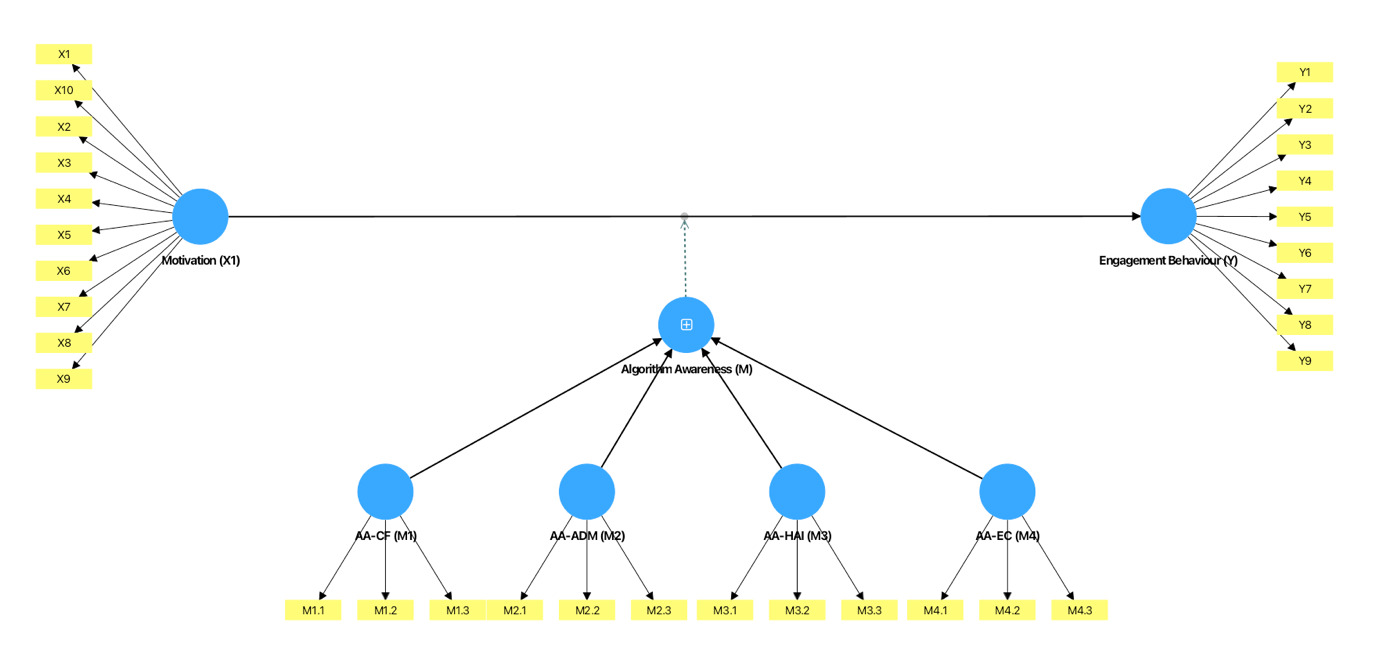
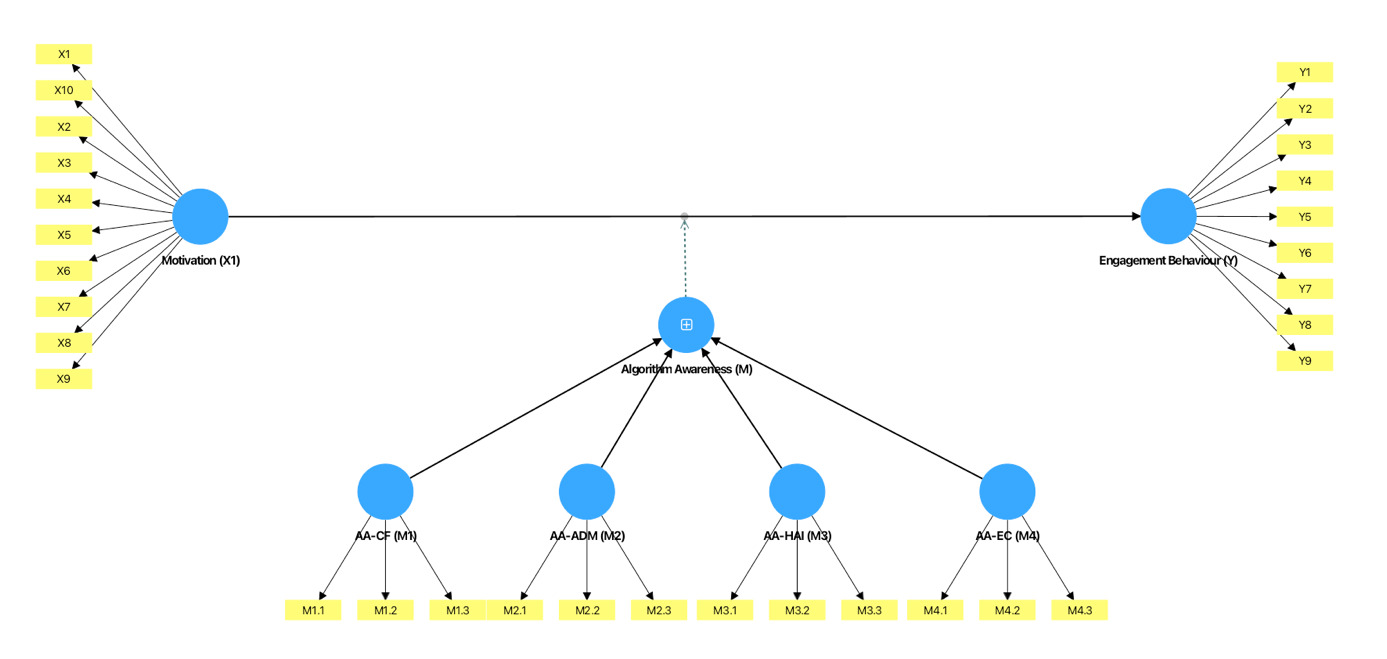
Figure 1 is the structural model with standardized path coefficients showing a significant positive effect of motivation on engagement behavior, a non-significant direct effect of algorithmic awareness, and a significant negative moderation between motivation and engagement. The four awareness dimensions, content filtering, automated decision-making, human-algorithm interaction, and ethical considerations, form the overall algorithmic awareness construct.
Motivation significantly predicted engagement behavior among Generation Z TikTok users (β = .122, p = .011). In contrast, algorithmic awareness showed a positive but non-significant direct effect (β = .088, p = .090), indicating that general understanding of TikTok’s curation system alone does not enhance engagement levels. Instead, the interaction term revealed a significant negative moderation (β = −.198, p < .001), confirming that higher algorithmic awareness weakens the positive relationship between motivation and engagement. This pattern suggests that users who are more aware of how TikTok’s algorithm operates engage more critically and selectively, reducing spontaneous participation even when motivation is high.
Based on the tertile-based classification, 171 respondents (40.4%) fell into the low algorithmic awareness category (scores ≤ 47), 134 respondents (31.7%) were in the medium awareness group (scores 48–49), and 118 respondents (27.9%) were in the high awareness category (scores ≥ 50).
Discussion
The distribution of respondents’ algorithm awareness reflects a relatively balanced segmentation, allowing a robust comparison across awareness levels in subsequent analyses. Unlike prior studies which found a majority of users to be in the high-awareness group, Felaco (2025) reveals a broader spread across awareness levels, suggesting diverse levels of critical engagement with algorithmic systems among Generation Z in South Jakarta. Similarly, Brodsky et al. (2020) argued that algorithmic awareness varies depending on digital literacy and individual experience with content curation systems. Users with higher awareness tend to develop a more critical and reflective stance, reducing passive content consumption.
Motivation and Engagement Behavior (H1)
The analysis revealed a significant positive effect of motivation on engagement behavior among Generation Z TikTok users in South Jakarta (β = .122, t = 2.553, p = .011). This supports the hypothesis that motivational drivers, such as entertainment, self-expression, social interaction, and trend-following, play a crucial role in fostering engagement among Generation Z TikTok users, who actively seek participatory and expressive online experiences. This aligns with the uses and gratifications framework (Blumler & Katz, 1974), which suggests that individuals actively seek media content that satisfies specific psychological and social needs; this also suggests that TikTok’s short-form and interactive design amplifies gratification-seeking behaviors, encouraging quick yet emotionally resonant participation. Recent studies confirm this pattern in TikTok contexts. For example, Zips & Holendová (2023) found that creativity expression and trend-seeking strongly motivate active participation, while Krisadhi et al. (2023) showed that motivations mediate the relationship between personality traits and TikTok usage intensity.
Direct Effect of Algorithmic Awareness
The direct effect of algorithmic awareness on engagement behavior was small (β = .088) and not statistically significant (t = 1.697, p = .090). This suggests that simply knowing how TikTok’s algorithms operate does not automatically increase or decrease engagement among Generation Z users. Academic literature supports this nuanced result. Zarouali et al. (2021) emphasized that algorithmic awareness serves as a foundational cognitive condition but does not uniformly predict behavioral outcomes. Similarly, Petrovčič et al. (2025) noted that algorithmic awareness may result in either skepticism and decreased trust (algorithmic aversion) or feelings of empowerment, depending on user perceptions and context. This non significance may indicate that algorithmic awareness functions more as a cognitive lens than a behavioral driver. Once users understand that TikTok’s recommendations are data-driven, they may consciously monitor or limit their interactions rather than act impulsively. In this sense, awareness shapes how users engage rather than how much they engage, a nuance later reflected in the moderation effect.
Moderating Role of Algorithmic Awareness (H2)
A significant negative moderation effect was found (β = –.198, t = 5.520, p < .001), indicating that higher algorithmic awareness weakens the positive impact of motivation on engagement behavior. In practical terms, even if Generation Z users are highly motivated to engage with TikTok, their engagement may decrease as they become more aware of how algorithms curate and recommend content.
This pattern reflects a shift from impulsive participation toward more deliberate and selective interaction. When users understand how the algorithm personalizes their feed, they become more conscious of their digital traces and may intentionally regulate their activity to control exposure or maintain authenticity. This indicates that algorithmic awareness enhances users’ self-regulation and critical evaluation of content rather than leading to disengagement.
This dynamic can also be understood through the notion of algorithmic imaginaries (Bucher, 2017), which describes how individuals imagine and interpret the influence of algorithms in their everyday media experiences. As users develop mental models of how TikTok’s recommendation system functions, they begin to critically assess which content deserves their attention and which does not. Such imagined understanding shapes behavioral restraint and reflective participation, showing that awareness operates cognitively before it manifests behaviorally.
These findings align with prior research suggesting that higher algorithmic literacy encourages selective and intentional engagement (L. Liu, 2024; Shin et al., 2022; Zarouali et al., 2021). In the context of Generation Z TikTok users in South Jakarta, this translates to more conscious participation; users still engage but do so more thoughtfully often choosing authentic, personally meaningful content over algorithmically promoted trends. Thus, algorithmic awareness functions as a cognitive moderator that enables users to reflect on their motivations and media choices. Motivation drives participation by fulfilling emotional and social gratifications, but awareness introduces an evaluative layer that shapes how these gratifications translate into behavior. This pattern also reflects algorithmic-aversion tendencies, where increased awareness of algorithmic influence leads users to consciously filter or resist excessive personalization.
These findings contribute to the emerging understanding of social media behavior in Southeast Asia, complementing predominantly Western research. Most prior studies on algorithm awareness and social media use have focused on Western users. For instance, algorithmic literacy studies in the United States and Europe report mixed attitudes: some users exhibit “algorithmic appreciation” while others show skepticism or algorithmic aversion (Oeldorf-Hirsch & Neubaum, 2023; Zarouali et al., 2021). The results suggest that Indonesian Generation Z users likewise engage critically when aware of algorithms, aligning with the aversion tendency. However, unlike Western contexts where concerns often center on privacy or fairness (Brodsky et al., 2020; Shin et al., 2022), in Southeast Asia the conversation may center on curation and authenticity. A qualitative study in Indonesia by Suharnanik et al. (2025) found that TikTok’s algorithm steers content exposure in ways that users gradually recognize and navigate. The quantitative evidence reinforces that in this locale, as users become aware of the algorithm’s influence, they deliberately filter their participation, a behavior that resonates with Southeast Asia’s digital culture of mindful and community-oriented social media use (Manesah, 2025).
Wang & Guo (2023) observed a similar moderation effect in China, where algorithm awareness tempered young people’s addictive TikTok use. The present study extends that pattern to a Southeast Asian context. This regional perspective is important: Southeast Asian TikTok users often blend global trends with local values (Abidin et al., 2023), and their motivations (participating in viral challenges or entrepreneurial content creation) may differ from Western users. The South Jakarta sample, for example, is part of a culture that leverages TikTok for both entertainment and community expression, from dance challenges to social commerce (Arkansyah et al., 2021; Krisadhi et al., 2023). Recognizing this, the moderating role of awareness might reflect a culturally informed skepticism: users enjoy the platform’s content but remain cautious about being “manipulated” by algorithms. Such a nuance adds a Southeast Asian voice to the literature, addressing the noted lack of research in this area and showing that theories like UGT and algorithmic literacy hold in this context while manifesting in locally specific ways.
Conclusion
This study examined how motivation and algorithmic awareness relate to engagement behavior among Generation Z TikTok users in South Jakarta. The results confirmed that motivation, driven by needs for entertainment, self-expression, social interaction, and participation in trends, significantly increases engagement behavior. This reinforces UGT’s premise that media consumption actively fulfills psychological and social needs.
In contrast, algorithmic awareness alone did not have a significant direct effect on engagement. This suggests that awareness of recommendation systems, while important for digital literacy, does not automatically translate into changes in user behavior. However, moderation analysis revealed a significant negative interaction between motivation and algorithmic awareness. This indicates that as users become more knowledgeable about algorithmic curation, they tend to engage more critically and selectively, even when motivation to use the platform is high. Such findings highlight the dual role of algorithmic literacy; it can empower users to make informed choices yet also reduce the spontaneity of engagement.
From a theoretical perspective, these findings extend the uses and gratifications framework by introducing algorithmic awareness as a moderating cognitive factor that shapes how motivational drivers translate into actual platform engagement. This positions algorithmic literacy not merely as a background competency, but as an active element influencing user–platform interaction.
Practically, the study underscores the need for platform designers, marketers, and content creators to adapt strategies for audiences with varying levels of algorithmic awareness. For highly literate users, transparency, ethical personalization, and features that enhance user agency may sustain meaningful engagement without compromising trust. For less-aware users, educational interventions could foster more intentional and healthier media use.
This study is not without limitations. First, the sample was limited to Generation Z TikTok users in a single urban area (South Jakarta). While this provided a focused context, it limits generalizability. The findings may not fully represent Generation Z behaviors in other regions or cultures, particularly in rural or non-urban settings. Second, the cross-sectional survey design and self-reported data mean the study cannot establish causality, and responses may be subject to common method bias (social desirability in reporting engagement levels). Future studies could employ longitudinal designs or incorporate actual usage data to verify causal directions. Third, although the non-probability purposive sample achieved the target number of respondents, it may introduce sampling bias; adopting random or stratified sampling would improve representativeness. Fourth, certain variables were beyond our scope since this study examined broad motivational categories and general algorithmic awareness but did not account for factors such as individual differences (personality, digital literacy), content genres, or frequency of TikTok use. These unmeasured factors could explain additional variance in engagement behavior. Finally, while PLS-SEM was appropriate for this exploratory model, it lacks a global goodness-of-fit index and is sensitive to indicator quality. This was mitigated by ensuring construct reliability and validity, but future research might complement PLS-SEM with covariance-based SEM or experimental methods to validate the relationships further.
Future research should examine these dynamics across different cultural and demographic contexts, as well as longitudinally to observe how algorithmic awareness evolves over time. Additionally, refining its measurement and exploring its interplay with other psychological or social variables could yield deeper insights into how algorithm-driven platforms can balance personalization, engagement, and user empowerment in diverse markets. Moreover, future studies could also investigate potential geographic differences within urban areas like South Jakarta, as this study did not analyze domicile-based variations despite collecting such data.