
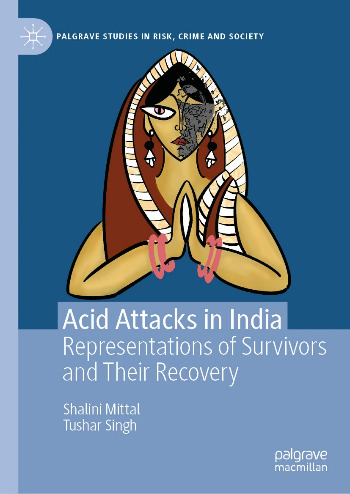
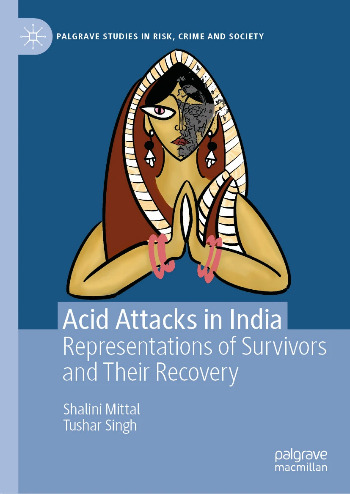
Acid attacks are among the most devastating forms of gendered violence, destroying both the body and a person’s sense of self. While this crime disproportionately affects women in South Asia, scholarly and public discussions have often overlooked the role of societal attitudes in perpetuating or mitigating such violence. Shalini Mittal and Tushar Singh’s Acid Attacks in India: Representations of Survivors and Their Recovery, published in 2025 in the Palgrave Studies in Risk, Crime and Society series, aims to address this gap by focusing public opinion as a critical lens for understanding the intersection of media, stigma, and policy. The book draws on a decade of fieldwork, including a public perception survey that reveals how ordinary Indians perceive acid attack survivors, specifically their stigma, empathy gaps, and the role of media in shaping these attitudes. These insights provide practical data for public opinion researchers to design surveys on gender-based violence and societal attitudes. By using both qualitative and quantitative evidence, the book goes beyond mere documentation of violence.
The book’s structure reflects its interdisciplinary approach, but its most significant contribution to public opinion scholarship lies in its analysis of how societal narratives shape survivor experiences. The book is divided into ten chapters, moving from historical and cultural backgrounds to psychological issues and policy needs. Chapter 1 begins with a broad historical overview of acid attacks, tracing their use from ancient Greece and Persia, through Victorian Britain and Glasgow’s industrial conflicts, to colonial India and modern South Asia. The authors frame these acts as products of cultural norms and power structures that are reinforced by public sentiment. By using Foucault’s theories of discipline, they highlight how public opinion can challenge or support systems of control. This idea is important for scholars who study how societal attitudes affect gender-based violence.
Chapter 2 introduces the idea of the “acid aesthetic” (p. 30), a cultural language that shapes how people view survivorship. The authors categorize this aesthetic into three types: the Disfigurative (focusing on victimhood), the Conflative (subsuming survivors into broader narratives of gender violence), and the Refigurative (emphasising agency) (p. 31). This framework helps public opinion researchers look at how media portrayals affect stigma, empathy, and support for policies. The chapter also questions whether fashion campaigns featuring survivors lead to real social change or just act as surface-level branding. Chapter 3 takes a deep dive into how literature depicts acid attacks, analyzing everything from Victorian and Edwardian tales by authors such as Conan Doyle (p. 58) to contemporary real-life biographies. Through the lens of Judith Butler’s precarity and grievability (p. 50), the chapter explores why society, and by extension, literature, often views these survivors as less deserving of sympathy. It points out a frustrating trend, i.e. stories frequently use survivors merely as plot twists or moral lessons, rather than letting them tell their own truths. While the chapter covers a wide range, the authors admit it lacks discussion on Indian-language literature, highlighting the ongoing struggle of rural and semi-urban survivors to get their voices heard.
Chapter 4 serves as the book’s core empirical and analytical analysis. The authors integrate clinical, social constructivist, gendered, and human rights frameworks to demonstrate the deep, inseparable connection between physical and psychological trauma. While the clinical perspective covers severe burn complications, extensive reconstructive surgeries, and respiratory risks, the empirical finding centers on pain assessment. The authors used the Faces Pain Scale (p. 72) with thirty survivors and found that all rated their pain as very high, even though their injuries varied. This suggests that many survivors had no way to compare such extreme pain and often had not heard of acid before being attacked. These findings question the usefulness of standard clinical tools and highlight the need for trauma-informed ways to measure pain. The chapter’s focus on social constructivism is specifically insightful. Using Erving Goffman’s idea of spoiled identity (p. 74) and Link and Phelan’s work on stigma (p. 82), this explains how disfigurement causes not only physical harm but also deep social harm to belonging and self-image. Survivor narratives in this chapter are compelling, especially the discussion of betrayal trauma, through the account of a woman attacked by her husband, highlighting the unique pain of violence by someone once trusted. Looking at acid attacks as human rights violations, including the rights to life, freedom from torture, privacy, and non-discrimination, is both morally important and helps connect India’s situation to global standards.
Chapter 5 stands out as the book’s most direct contribution to understanding societal attitudes. Here, the authors present findings from a public perception survey that examines how ordinary Indians view acid attack survivors, their stigma, and the role of media in shaping these attitudes. While the survey primarily supports the book’s arguments, its methodological approach, combining quantitative and qualitative data, provides a template for future studies on public attitudes toward marginalized groups. The chapter also discusses cognitive biases among acid attack survivors, such as overgeneralization, ideas about fairness and justice (p. 100), hindsight bias and counterfactual thinking (p. 102), and catastrophizing (p. 104). Using Aron Beck’s cognitive theory of psychopathology (p. 105), the chapter shows how these thought patterns, while understandable after trauma, can make recovery harder by keeping survivors stuck in hopelessness, shame, and isolation. Chapter 6 explores the physical and psychological dimensions of trauma, delving into the long-term effects of acid attacks on survivors’ health, including chronic pain, disfigurement, and mental health challenges. The chapter stresses the interconnectedness of physical and emotional suffering, highlighting how societal stigma exacerbates the psychological burden of recovery.
Chapter 7 develops a model for psychological rehabilitation, proposing community-based interventions to address shame, self-esteem, social reintegration, catharsis, and cognitive restructuring. The chapter highlights how individual recovery depends on shifting public attitudes, emphasizing the link between personal healing and societal change. Chapter 8 explores post-traumatic growth, presenting survivor testimonies that illustrate how some individuals transform suffering into advocacy and purpose, without romanticizing resilience as universal. Chapter 9 examines legal and institutional responses, from the lack of laws before 2013 to the Criminal Law Amendment Act and the Bharatiya Nyaya Sanhita (BNS) 2023 (India’s official criminal code that came into effect on July 1, 2024, replacing the colonial-era Indian Penal Code, 1860 (IPC)). The authors show how public demand for justice, driven by media and advocacy, led to legal reforms, while implementation gaps persist, including slow prosecutions and sloppy regulation of acid sales. The final chapter summarizes the findings and outlines challenges in prevention, support, and policymaking.
One of the book’s key strengths is its careful use of the terms “victim” and “survivor,” employed contextually to emphasize injustice or resilience, avoiding reduction of individuals to a single experience. The authors demonstrate ethical sensitivity by using pseudonyms, maintaining confidentiality, and protecting participants. Methodologically, the book’s mixed-methods design, combining survivor interviews, psychological assessments, field observations, and a public perception survey, enhances its relevance by capturing societal attitudes, stigma, and media influence that shape survivor experiences. While its interdisciplinary approach is a strength, a deeper discussion of the public perception survey’s methodology (e.g., sample design, demographic scope) would have strengthened its utility in understanding how public opinion intersects with recovery and advocacy. The book also identifies significant gaps in existing scholarship, specifically the underrepresentation of male survivors in media, literature, and advocacy. An unexpected but thought-provoking discussion of acid attacks on animals broadens the conversation around acid violence and societal responses to cruelty.
Acid Attacks in India: Representations of Survivors and Their Recovery offers a rigorous and well-researched contribution to the study of gender-based violence. By centering survivor experiences, the book demonstrates that recovery is influenced not only by legal, medical, and psychological interventions but also by public perceptions and broader social responses. For scholars of public opinion research and societal attitudes, the book’s most valuable insights lie in its exploration of how public perception surveys, media narratives, and advocacy efforts can help challenge stigma, build empathy, and influence policy. While the book’s theoretical discussions, including Foucault’s Discipline and Punish (1977) (Ch. 1, on how public sentiment reinforces systems of control and punishment in acid attacks as gender-based violence), Goffman’s spoiled identity (1963) and Link & Phelan’s stigma theory (2001) (Ch. 4, on survivors’ societal exclusion), and Butler’s precarity (2004) (Ch. 3, on media portrayals of survivors as less deserving of sympathy), could be more cohesively integrated, they directly inform public opinion research by showing how societal attitudes shape stigma, empathy, and policy support. Though this integration and the analysis of the public perception survey could benefit from greater methodological detail, these limitations do not significantly weaken the book’s overall impact. This work will be valuable to scholars and practitioners engaged with gender-based violence, media representation, public attitudes, and social justice.